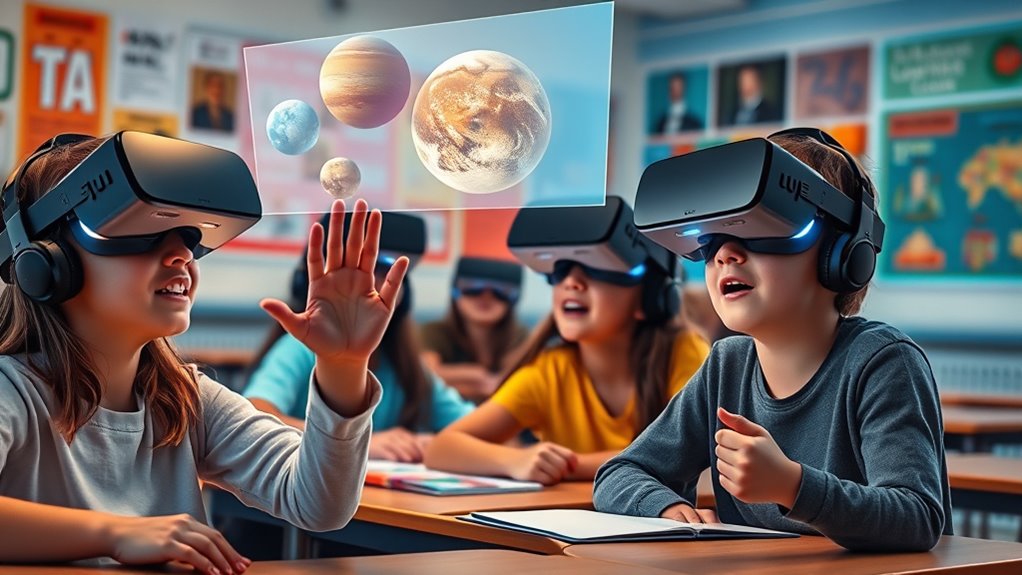
AR and VR are changing how you learn by bringing the classroom to life. Instead of just textbooks, you can explore ancient cities or conduct virtual science experiments. These technologies engage various learning styles, letting you interact with detailed models or participate in hands-on activities. You’ll collaborate with peers and develop essential skills for the future. If you’re curious about how these immersive tools can enhance your educational experience, there’s so much more to uncover.
Key Takeaways
- AR and VR transform education by offering immersive experiences, allowing students to explore historical sites and scientific concepts interactively.
- Traditional learning methods are enhanced as AR overlays digital information, making complex ideas more tangible and promoting active participation.
- VR environments create fully immersive settings, enabling safe exploration of places like Mars or conducting experiments impossible in real life.
- These technologies cater to diverse learning styles, engaging visual, kinesthetic, and auditory learners through interactive and hands-on experiences.
- AR and VR foster collaboration and communication skills, preparing students for a future where technology and creativity are essential.

As technology evolves, educators are discovering the transformative power of augmented reality (AR) and virtual reality (VR) in the classroom. These immersive technologies aren’t just tools; they’re gateways to new learning experiences. Imagine stepping into a history lesson where you can walk through ancient Rome or witnessing a science experiment that comes to life right before your eyes. With AR and VR, you’re not just reading about these subjects; you’re experiencing them firsthand.
Discover the transformative power of AR and VR, where learning becomes an immersive experience, bringing history and science to life.
When you think about traditional learning methods, they often rely on textbooks and lectures. But with AR, you can overlay digital information onto the real world. This means you can hold a tablet or use smart glasses to see 3D models of the human body, planets, or even historical artifacts as if they’re right in front of you. This interaction engages your senses, making complex ideas more tangible and easier to understand. You’re not just a passive listener; you become an active participant in your learning journey.
VR takes this a step further by creating entirely immersive environments. Picture yourself in a virtual lab conducting experiments that would be impossible or unsafe in real life. You can explore the depths of the ocean or the surface of Mars without ever leaving the classroom. This level of engagement fosters curiosity and encourages exploration, allowing you to ask questions and seek answers in ways that traditional methods can’t facilitate.
Moreover, AR and VR cater to different learning styles. Whether you’re a visual learner who benefits from graphics, a kinesthetic learner who thrives on hands-on experiences, or an auditory learner who absorbs information through discussion, these technologies can adapt to your needs. This personalization enhances retention and comprehension, making it easier for you to grasp challenging concepts. Additionally, incorporating tools like essential oils for toothache relief can create a more holistic approach to learning by addressing student wellness.
However, integrating AR and VR into the classroom isn’t just about the technology itself. It’s about how you and your peers interact with it. Collaborative experiences can lead to discussions that deepen understanding, as you share insights and perspectives. Working together in a virtual space creates a sense of community, fostering teamwork and communication skills essential for the future.
As you navigate this new educational landscape, you’ll find that AR and VR are reshaping how you learn. They make education more interactive, engaging, and fun. By embracing these tools, you’re not just preparing for tests; you’re preparing for life in a world where technology and creativity intersect.
AR educational tablets for students
As an affiliate, we earn on qualifying purchases.
As an affiliate, we earn on qualifying purchases.
Frequently Asked Questions
What ARe the Costs Associated With Implementing AR and VR in Education?
Implementing AR and VR in education can be costly. You’ll need to invest in hardware like headsets and devices, which can run from hundreds to thousands of dollars. Software licenses and development costs can add up, too. Training teachers to effectively use these technologies requires time and resources. Additionally, maintaining and updating the technology can lead to ongoing expenses. Overall, it’s vital to budget carefully to guarantee a successful implementation.
How Can Teachers Be Trained to Effectively Use AR and VR Tools?
To effectively use AR and VR tools, you should start by participating in professional development workshops focused on these technologies. Collaborating with tech-savvy colleagues can also enhance your skills. It’s essential to experiment with different applications in your lesson plans, and don’t hesitate to seek feedback from your students. Joining online communities or forums can provide ongoing support and resources, helping you integrate these tools seamlessly into your teaching practice.
ARe There Age Restrictions for Using AR and VR in Schools?
Yes, there are age restrictions for using AR and VR in schools. Many platforms recommend specific age ranges, often 13 and up, due to safety concerns and content appropriateness. It’s important to verify each tool’s guidelines and make certain you’re following local regulations. Additionally, consider your students’ maturity levels and the complexity of the content. Always prioritize creating a safe and effective learning environment when incorporating these technologies into your classroom.
What Technical Support Is Needed for AR and VR Classroom Setups?
Setting up AR and VR in classrooms can feel like launching a spaceship! You’ll need robust Wi-Fi, powerful computers or tablets, and compatible headsets. Don’t forget to make sure software is up-to-date and user-friendly. Train your teachers on troubleshooting common issues, and consider having tech support on standby during sessions. With the right technical support, you’ll create an engaging learning environment that captivates students and enhances their educational experience.
How Can AR and VR Accommodate Different Learning Styles?
AR and VR can accommodate different learning styles by providing interactive experiences tailored to individual needs. If you’re a visual learner, these technologies can present information through engaging visuals and simulations. For auditory learners, immersive environments can incorporate soundscapes and narrated content. Kinesthetic learners benefit from hands-on activities that allow them to manipulate objects in a virtual space. By offering diverse experiences, AR and VR guarantee that everyone can engage and learn effectively.

UNGLINGA 150 Experiments Science Kits for Kids Chemistry Lab S.T.E.MToys
- Number of Experiments: 150 science experiments for kids
- Educational Topics: Earth, surface tension, chemistry, physics
- Instruction Manual: Well-illustrated, step-by-step guide
As an affiliate, we earn on qualifying purchases.
As an affiliate, we earn on qualifying purchases.
Conclusion
Incorporating AR and VR in the classroom transforms learning into an engaging, interactive experience. For instance, imagine a history class where students explore Ancient Egypt through a VR simulation, walking among the pyramids and interacting with historical figures. This hands-on approach not only deepens understanding but also ignites passion for the subject. As educators embrace these technologies, they’ll open new pathways for creativity and collaboration, preparing students for a future where immersive learning is the norm.

VictoryXR Space and Planets Augmented Reality Card Deck | Augmented Reality Space Learning Package
- Number of AR Learning Cards: 54 cards with AR and text
- Multi-Game Functionality: AR learning, memory, and standard card games
- Space Exploration Content: Learn about planets, NASA, and space objects
As an affiliate, we earn on qualifying purchases.
As an affiliate, we earn on qualifying purchases.

Heromask VR Headset for Kids 5-12 · Math Games in Virtual Reality
- Math Learning Fun: Engaging games for math skills
- Includes VR Headset: Sturdy, comfortable VR headset included
- Teacher-Designed Brain Games: Educational games to boost fluency and confidence
As an affiliate, we earn on qualifying purchases.
As an affiliate, we earn on qualifying purchases.