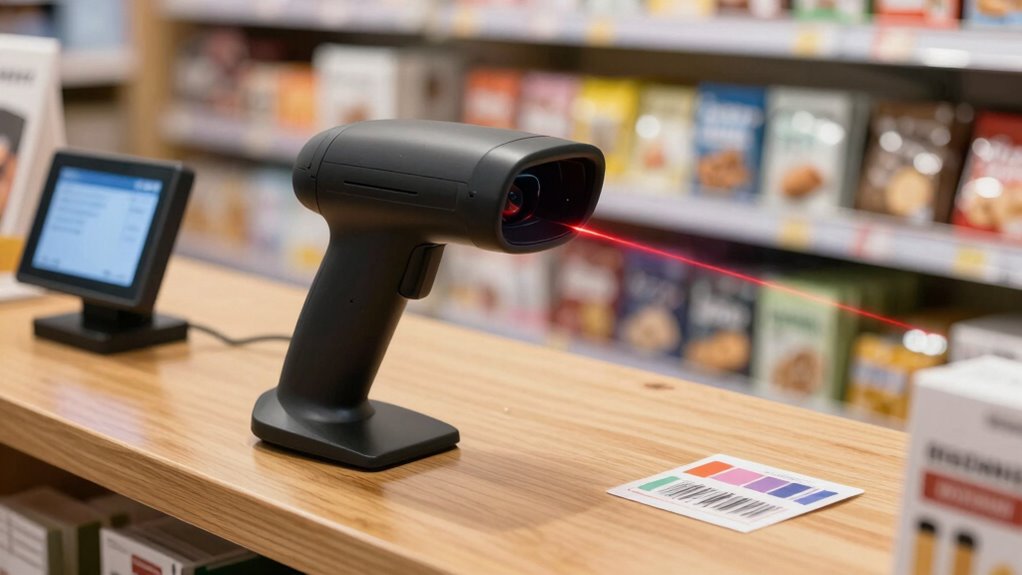

For small retailers, choosing between wired and wireless barcode scanners depends on your store layout and transaction volume. Wireless scanners offer mobility, making it easier to scan items anywhere in your store, while wired ones are reliable and simpler to maintain, ideal for fixed checkout counters. Handheld models are versatile and good for various tasks, whereas fixed scanners are best for high-speed, high-volume environments. Keep exploring to find the perfect fit for your retail setup.

Get your next haul delivered free — and shop member deals
- Fast, free delivery on millions of items
- Access to Prime Big Deal Days deals on October 6–7
- Prime Video, Amazon Music and more included
Key Takeaways
- Wireless scanners improve mobility and customer service, ideal for flexible store layouts.
- Wired scanners are reliable, affordable, and suitable for fixed checkout counters.
- Handheld scanners offer portability and convenience for varied scanning tasks.
- Fixed scanners are designed for high-volume, fast-paced transactions at specific points.
- Choosing between wireless or wired depends on store size, transaction volume, and operational needs.
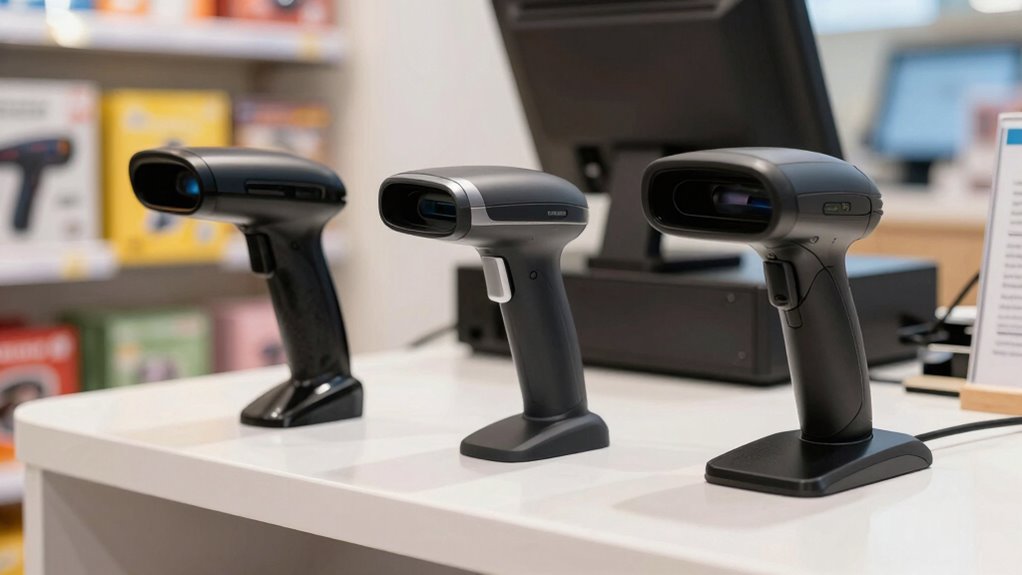
Choosing the right barcode scanner can considerably streamline your retail operations, but with so many types available, it’s easy to feel overwhelmed. One of the first decisions you’ll need to make is whether to go for a wireless or wired scanner. Wireless connectivity offers significant advantages, especially if you need mobility around your store. With a wireless scanner, you’re not limited by cords, allowing you to scan items anywhere on the sales floor, at the cash register, or even in storage areas. This flexibility speeds up checkout lines and improves customer service. Plus, wireless scanners often come with Bluetooth or Wi-Fi capabilities, making it simple to connect to your POS system without hassle.
Wireless scanners enhance mobility, speed up checkout, and simplify POS system connectivity with Bluetooth or Wi-Fi.
On the other hand, wired scanners tend to be more straightforward, often more affordable, and require less maintenance. If your store has a fixed checkout counter with limited space, a wired scanner might be your best choice. They’re reliable and don’t depend on batteries, so you won’t have to worry about recharging or replacing batteries. However, the trade-off is that they restrict your movement, which can slow down busy checkout lines or limit flexibility around the store. Wired scanner reliability can be a significant factor in choosing a model for high-volume retail environments. Additionally, considering the types of barcode scanners available can help you select the best fit for your specific needs.
When considering handheld versus fixed barcode scanners, think about how you plan to use them. Handheld scanners are versatile and easy to use—simply pick them up, scan an item, and put them down. They’re ideal for small retail settings or situations where staff need to scan items from different locations. These scanners are portable, often equipped with wireless connectivity, which makes them convenient for quick, on-the-go scanning tasks. It’s also important to consider barcode scanner technology when choosing a model, as different types may be better suited for specific types of barcodes or scanning environments.
Fixed scanners, on the other hand, are installed in a specific location, usually at checkout counters. They’re designed for high-volume scanning, such as at a cashier station, and are usually fixed in place with a stand or mount. Fixed scanners tend to be faster and more durable, making them suitable if your store handles a high number of transactions daily. They often integrate seamlessly with your POS system and can be configured to scan items automatically when placed in the scanning zone. Incorporating barcode scanner types into your setup can help you optimize efficiency based on your operational needs.
wireless barcode scanner for retail
As an affiliate, we earn on qualifying purchases.
As an affiliate, we earn on qualifying purchases.
Frequently Asked Questions
How Do Barcode Scanners Impact Checkout Speed?
Barcode scanners considerably boost checkout speed by quickly reading product information, reducing the time staff spends manually entering data. This improvement enhances inventory accuracy and minimizes errors, leading to smoother transactions. With proper staff training, your team can operate scanners efficiently, ensuring faster service and happier customers. Overall, barcode scanners streamline the checkout process, making it more efficient and reliable for your small retail business.
Are Wireless Barcode Scanners More Secure Than Wired Ones?
Wireless barcode scanners can be more secure than wired ones if they use strong wireless security features like data encryption and secure pairing protocols. You should look for scanners that support the latest wireless security standards to protect sensitive data during transmission. While wired scanners inherently have less risk of wireless breaches, ensuring your wireless scanner uses robust data encryption gives you peace of mind and safeguards your retail data effectively.
What Is the Typical Lifespan of a Barcode Scanner?
You might worry about replacing your scanner often, but with proper maintenance, a barcode scanner typically lasts 3 to 5 years. Its lifespan depends on barcode durability and regular scanner calibration, which guarantee consistent performance. Investing in quality devices and routine checks can extend their usability. Remember, a well-maintained scanner reduces downtime and saves you money, making it a smart choice for your retail operations.
Can Barcode Scanners Read QR Codes?
Yes, many barcode scanners can read QR codes, but it depends on the scanner’s compatibility with different QR code variants. You should check the scanner’s specifications to verify it supports QR code reading. Modern laser and imaging scanners are generally capable of reading QR codes, including those with logos or different sizes. This compatibility helps you streamline checkout processes and inventory management without needing separate devices.
Do Barcode Scanners Require Special Software to Operate?
No, barcode scanners usually don’t need special software to operate. They are typically plug-and-play, working directly with your existing hardware setup, which makes inventory management easier. However, you should check hardware compatibility before buying, especially if you plan to integrate it with specific POS systems. Most scanners transmit data to your device, allowing seamless stock updates without extra software, streamlining your retail operations.
wired barcode scanner for checkout counter
As an affiliate, we earn on qualifying purchases.
As an affiliate, we earn on qualifying purchases.
Conclusion
Choosing the right barcode scanner can revolutionize your small retail store, transforming it into a lightning-fast, ultra-efficient powerhouse. Imagine scanning items at the speed of light, with your fingers practically doing the work for you, leaving chaos and long lines in the dust. With the perfect scanner, you’ll feel like you’ve discovered a secret weapon, turning your shop into a well-oiled machine that dazzles customers and leaves competitors in awe. Get ready to elevate your retail game to legendary status!
handheld barcode scanner Bluetooth
As an affiliate, we earn on qualifying purchases.
As an affiliate, we earn on qualifying purchases.
fixed barcode scanner for high volume store
As an affiliate, we earn on qualifying purchases.
As an affiliate, we earn on qualifying purchases.
Fall Picks
fall essentials
As an affiliate, we earn on qualifying purchases.