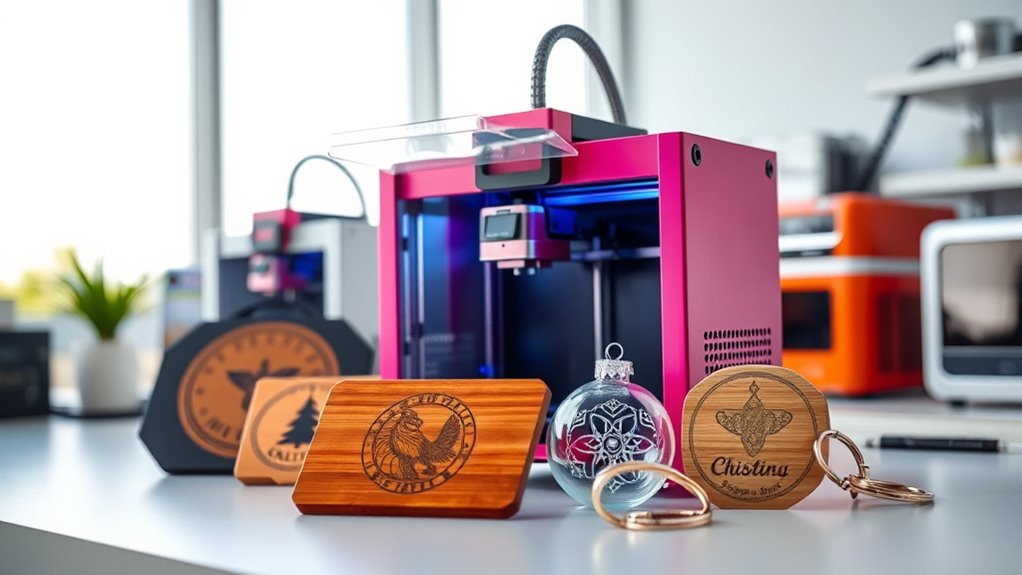

For most hobbyists, I’d start with the xTool M2 10W: its enclosure and dual cameras suit a home workshop where setup and positioning matter. The Twotrees TTS-10 Pro offers a larger open work area, while the LaserPecker LP2 favors portability and curved-object work with its roller. The central tradeoff is between a spacious, open-frame machine and a more contained or portable setup, with work area, material compatibility, and workflow varying across these 14 models. Small engraving zones can be limiting for larger projects, while open frames call for more workspace planning and supervision. Read on for how I’d match each engraver to a hobbyist’s needs.

Get your next haul delivered free with Prime
- Fast, free delivery on millions of items
- Prime Video, Amazon Music and more included
- Member-only deals all year
Key Takeaways
- The xTool M2 10W stands apart for hobbyists who value an enclosed setup and dual cameras; the open-frame Twotrees TTS-10 Pro gives more room for larger flat projects.
- The Twotrees TTS-10 Pro and Creality Falcon 5W offer notably larger listed work areas than the compact 130 × 130 mm options, a meaningful distinction for signs and repeated batch work.
- The LaserPecker LP2 pairs portable operation with a rotary roller, making it the lineup’s clearest fit for curved objects rather than broad flat panels.
- The Aliencell X1 is listed as a 40W machine with no-PC operation, but its higher output and workflow call for careful checking of materials, space, and operating needs before buying.
- Several models cluster around compact work areas and lower listed power, so choosing between them should hinge on setup, software, connectivity, and intended projects—not headline wattage alone.
| Twotrees TTS-10 Pro Laser Engraver, 10W High Power, 300x300mm Work Area, Compatible with LightBurn & LaserGRBL |  | Best Overall for Larger Hobby Projects | Laser power: 10W | Work area: 300 × 300 mm | Laser spot size: 0.069 mm | VIEW ON AMAZON | See Our Full Breakdown |
| LaserPecker LP1 Plus Mini Laser Engraver with Adjustable Stand |  | Best for Portable Personalization | Model: LP1 Plus | Lens-to-material distance: 200 mm | Supported materials: Wood, leather, acrylic, paper, and other compatible non-metal materials | VIEW ON AMAZON | See Our Full Breakdown |
| xTool M2 10W Enclosed Laser Engraver with Dual Cameras |  | Best Enclosed Pick for Beginners | Laser type: 10W diode laser | Laser output power: 10,000 mW | Safety class: Class 1 | VIEW ON AMAZON | See Our Full Breakdown |
| ACMER S1 Laser Engraver, 3500mW, 130x130mm Working Area, High Precision Laser Cutter and Engraving Machine |  | Best Compact Starter Frame | Laser power: 3500 mW | Wavelength: 455 ± 5 nm | Focal length: 2 mm | VIEW ON AMAZON | See Our Full Breakdown |
| 7W Diode Laser Engraver |  | Best Value for Small Craft Work | Laser output: 7W | Engraving accuracy: 0.01 mm | Working area: 200 × 150 mm | VIEW ON AMAZON | See Our Full Breakdown |
| LaserPecker LP2 Laser Engraver with Roller |  | Best for Portable Rotary Engraving | Maximum engraving speed: 1,417 in/min | Frame and graphic preview speed: 8,858 in/min | Compressed spot: 0.05 mm | VIEW ON AMAZON | See Our Full Breakdown |
| ACMER S1 2500mW Laser Engraver and Cutter |  | Best for Quick Setup and Fine Positioning | Laser power: 2,500 mW | Machine output: 24 W | Wavelength: 455 ± 5 nm | VIEW ON AMAZON | See Our Full Breakdown |
| ATOMSTACK P1 5W Laser Engraver |  | Best Enclosed Starter Pick | Listed laser power: 5 mW | Engraving area: 110 × 110 mm | Maximum processing height: 50 mm | VIEW ON AMAZON | See Our Full Breakdown |
| Woxcker L2 MAX 20W Laser Cutter and Engraver |  | Best for a Larger Enclosed Workspace | Laser power: 20 W | Bed size: 300 × 300 mm | Focus precision: 0.01 mm | VIEW ON AMAZON | See Our Full Breakdown |
| LONGER Ray5 Mini Laser Engraver |  | Best Compact Speed Pick | Laser power: 5.5 W | Work area: 130 × 130 mm | Maximum speed: 12,000 mm/min | VIEW ON AMAZON | See Our Full Breakdown |
| LaserVii L1 Mini Laser Engraver, 3000mW Desktop Cutter, 150x150mm Area |  | Best Compact Pick | Laser power: 3W | Work area: 150 × 150 mm | Maximum engraving speed: 12,000 mm/min | VIEW ON AMAZON | See Our Full Breakdown |
| Aliencell X1 40W Laser Engraver & Cutter, No PC Needed |  | Best for Large Batch Projects | Bed size: 26 × 21 inches | Laser power: 40W | Acceleration: 20,000 mm/s² | VIEW ON AMAZON | See Our Full Breakdown |
| Twotrees TTS-55 Pro 5.5W Laser Engraver |  | Best Hobbyist All-Rounder | Laser power: 5.5W (5500mW) | Laser class: Class II | Work area: 300 × 300 mm | VIEW ON AMAZON | See Our Full Breakdown |
| Creality Falcon 5W Laser Engraver and Cutter, 400 × 415 mm Work Area |  | Best for Large Flat Designs | Laser output: 5W (5000mW) | Laser class: Class 4 | Working area: 400 × 415 mm | VIEW ON AMAZON | See Our Full Breakdown |
More Details on Our Top Picks
Twotrees TTS-10 Pro Laser Engraver, 10W High Power, 300x300mm Work Area, Compatible with LightBurn & LaserGRBL
For hobbyists who want room to grow beyond small tags and ornaments, the Twotrees TTS-10 Pro pairs a 10W laser with a generous 300 × 300 mm work area. That footprint and its metal frame make it a more substantial workshop machine than the compact ACMER S1, while support for LightBurn and LaserGRBL gives experienced makers familiar software options. TF card, mobile app, and web operation also let you run jobs without keeping a computer beside the engraver.
The larger bed calls for careful measuring, and diode compatibility has limits: bare steel needs surface treatment, and the machine is not a universal metal engraver. Choose it when project size and versatile control matter more than portability; skip it if your work mostly fits in a small desktop footprint.
Pros:- 10W optical output supports faster, deeper engraving than the lower-power compact picks
- 300 × 300 mm work area accommodates projects too large for the ACMER S1
- TF card, mobile app, and web control support computer-free operation
- Aluminum alloy frame provides a sturdy base for workshop use
Cons:- Bare steel and other untreated metals need surface treatment
- Large work area requires careful project measurement and more bench space
- Small laser spot may not suit every engraving style or application
Best for: Hobbyists making larger signs, panels, and repeat craft projects who want a roomy bed and several control options.
Not ideal for: Makers who need a portable machine or expect to engrave bare metal directly.
- Laser power:10W
- Work area:300 × 300 mm
- Laser spot size:0.069 mm
- Maximum engraving speed:30,000 mm/min
- Frame material:Aluminum alloy
- Main board:32-bit dual-core MCU
- Connectivity:TF card, mobile app, and web
Our verdict“Choose the TTS-10 Pro if your hobby projects need a large bed and strong diode output, and you have room for a fixed workshop machine.”
LaserPecker LP1 Plus Mini Laser Engraver with Adjustable Stand
The LaserPecker LP1 Plus is the lineup’s portability pick: its compact body, magnetic base, and 360° adjustable stand suit hobbyists who want to personalize small compatible items in different positions. Its cross-platform app can import photos and drawings, making quick custom motifs more approachable than a machine-centered workflow. Unlike the Twotrees TTS-10 Pro, it is designed around flexible placement rather than a large fixed work area.
That convenience comes with a narrower material range. Metal engraving is unsupported, and the lens must stay precisely 200 mm from the material, so setup is less forgiving than the xTool M2’s camera-assisted workspace preview. Pick this for portable, non-metal projects; pass if you need broad material capability, a large bed, or relaxed positioning.
Pros:- Compact design is easy to move and store
- Adjustable stand and magnetic base allow flexible positioning
- Cross-platform app imports photos and drawings
- Can run from a compatible power bank
Cons:- Does not support metal engraving
- Requires an exact 200 mm lens-to-material distance
- Portable format is less suited to larger batch projects than the Twotrees TTS-10 Pro
Best for: Hobbyists personalizing small wood, leather, or acrylic items who value portability and app-based artwork import.
Not ideal for: Makers who need metal engraving, a large fixed work area, or a setup that tolerates varying material distance.
- Model:LP1 Plus
- Lens-to-material distance:200 mm
- Supported materials:Wood, leather, acrylic, paper, and other compatible non-metal materials
- Metal engraving:Not supported
- Stand:Adjustable with 360° positioning
- Power:Compatible with power banks
- App:Cross-platform
Our verdict“Choose the LP1 Plus for portable, app-driven personalization on compatible non-metal materials, provided its precise spacing requirement fits your workflow.”
xTool M2 10W Enclosed Laser Engraver with Dual Cameras
Hobbyists who want a contained setup and help placing designs may prefer the xTool M2. Its fully enclosed Class 1 design and dual cameras provide workspace monitoring and a preview for material placement, while xTool Studio adds templates and an AI image generator. That guided workflow is a clear contrast with the more open, software-flexible Twotrees TTS-10 Pro, which may appeal more to makers already comfortable setting up jobs themselves.
The M2’s 10W diode handles a broad set of craft materials, including felt, fabric, and cardstock. Its expansion path is useful, but the CMYK, rotary, and 3W IR modules are optional; fine metal and plastic engraving depends on the IR add-on. Choose it for an enclosed, camera-assisted craft station, and account for the limits of the base configuration when planning specialty projects.
Pros:- Fully enclosed Class 1 design with real-time monitoring
- Dual cameras help preview the workspace and position materials
- Supports a broad range of craft materials, including fabric and cardstock
- xTool Studio includes templates and an AI image generator
Cons:- CMYK inkjet and rotary modules are sold separately
- Fine metal and plastic engraving requires the optional 3W IR laser
- Less suited to buyers who prefer open access and software choice like the Twotrees TTS-10 Pro
Best for: Newer hobbyists working with varied craft materials who want an enclosed machine, camera previews, and guided software tools.
Not ideal for: Buyers who need rotary, CMYK, or fine metal engraving capabilities included in the base setup.
- Laser type:10W diode laser
- Laser output power:10,000 mW
- Safety class:Class 1
- Enclosure:Fully enclosed
- Cameras:Dual built-in cameras
- Compatible materials:300+ materials, including wood, leather, felt, fabric, paper, and cardstock
- Software:xTool Studio
- Optional add-ons:CMYK Inkjet module, RA3 Lite Rotary, and 3W IR laser
Our verdict“Choose the xTool M2 if an enclosed, camera-assisted workflow is your priority and you are comfortable adding modules for specialty tasks.”
ACMER S1 Laser Engraver, 3500mW, 130x130mm Working Area, High Precision Laser Cutter and Engraving Machine
The ACMER S1 suits hobbyists who want a compact, approachable frame for small, detailed work. It arrives preassembled, weighs 2 kg, and supports AcmerTool, LightBurn, and LaserGRBL, so buyers can start with the supplied software or move to familiar alternatives. Its 130 × 130 mm area is far smaller than the Twotrees TTS-10 Pro’s bed, but that compact footprint makes more sense for tags, small panels, and limited bench space.
The 3.5W diode and small work area set firm boundaries: larger projects will need to be split or handled on a bigger machine, and claims around commercial safety features should be checked for the intended setting. Compared with the 7W engraver in this batch, the ACMER emphasizes a lightweight, preassembled format over greater stated output. Pick it for modest projects and easy setup, not production scale.
Pros:- Preassembled design and quick laser head installation simplify setup
- Compact 2 kg build is easy to move
- Supports AcmerTool, LightBurn, and LaserGRBL
- Stated engraving accuracy is 0.01 mm
Cons:- 130 × 130 mm work area restricts project size
- 3.5W output is lower than the 7W engraver’s stated output
- Laser safety and certification details may need verification for commercial use
Best for: Hobbyists with limited bench space who want a preassembled machine for small, detailed wood, leather, or craft projects.
Not ideal for: Makers producing large pieces, seeking higher laser output, or needing verified safety provisions for commercial use.
- Laser power:3500 mW
- Wavelength:455 ± 5 nm
- Focal length:2 mm
- Working area:130 × 130 mm
- Machine size:250 × 250 × 162 mm
- Weight:2 kg
- Supported software:AcmerTool, LightBurn, and LaserGRBL
- Material compatibility:Wood, bamboo, leather, plastic, PCB, aluminum oxide, and ceramics
Our verdict“Choose the ACMER S1 for small hobby projects and easy setup when a compact footprint matters more than bed size or laser output.”
7W Diode Laser Engraver
This 7W diode engraver offers hobbyists a useful middle ground between the 3.5W ACMER S1 and the 10W Twotrees TTS-10 Pro. Its 200 × 150 mm work area fits small craft pieces, while the stated 0.01 mm accuracy suits detailed designs. A foldable frame can help when a permanent workstation is not available, and the machine can cut basswood up to 4 mm thick with multiple passes.
That cutting claim comes with time and material limits: repeated passes are needed, and the bed is not sized for large panels. The listed materials include coated metal, while bare metal needs marking spray for best results. Compared with the compact ACMER, this pick offers higher stated output and a wider bed; compared with the Twotrees, it gives up both work area and maximum speed. It makes sense for small, varied crafts rather than large or fast jobs.
Pros:- 7W laser output sits between the ACMER S1 and Twotrees TTS-10 Pro
- 0.01 mm stated engraving accuracy supports detailed designs
- Can cut basswood up to 4 mm thick with multiple passes
- Foldable design saves workspace
Cons:- 200 × 150 mm work area limits project dimensions
- Basswood cutting requires multiple passes
- Bare metal needs marking spray for best results
Best for: Hobbyists making detailed small crafts who want a foldable machine and occasional thin-basswood cutting.
Not ideal for: Makers handling large panels, seeking fast cutting, or expecting direct results on bare metal.
- Laser output:7W
- Engraving accuracy:0.01 mm
- Working area:200 × 150 mm
- Maximum speed:10,000 mm/min
- Cutting capacity:Up to 4 mm basswood with multiple passes
- Compatible materials:Wood, leather, kraft paper, bamboo, dark acrylic, and coated metal
- Design:Foldable
Our verdict“Choose this 7W engraver for detailed, small-scale craft work and occasional thin-basswood cuts if you can work within its compact bed.”
LaserPecker LP2 Laser Engraver with Roller
The LaserPecker LP2 stands apart from the frame-based ACMER S1 and LONGER Ray5 Mini by pairing a handheld laser unit with an included electric roller. That setup is useful for hobbyists personalizing tumblers, pencils, and other cylindrical items, while its trolley mode can extend engraving length to 196 inches on a narrow 4-inch width. Its compressed spot and selectable resolutions support detailed small designs, and the compact unit is easier to move between work areas than a larger desktop engraver. The tradeoff is a restricted material range: it engraves coated metal, not bare or shiny metal, and light or transparent materials need dark coating first. Its 4-inch engraving width also makes it a poor fit for broad projects.
Pros:- Included electric roller supports cylindrical objects
- Trolley mode supports engraving lengths up to 196 inches
- Handheld form and compact size suit portable work
- Three resolution options and a 0.05 mm compressed spot support detailed designs
Cons:- Cannot engrave pure or shiny metal
- Engraving width is limited to 4 inches
- Light-colored and transparent materials need dark coating before engraving
Best for: Hobbyists who want to personalize cylindrical objects and move a compact engraver between workspaces
Not ideal for: Makers focused on bare metal engraving or wide, full-bed projects
- Maximum engraving speed:1,417 in/min
- Frame and graphic preview speed:8,858 in/min
- Compressed spot:0.05 mm
- Resolution options:1K, 1.3K, and 2K
- Maximum trolley engraving length:196 in
- Engraving width:4 in
- Supported connections:Smartphone or PC
- Supported file formats:JPG, PNG, G-code, and more
Our verdict“Choose the LP2 if portable, narrow-format engraving on cylindrical items matters more than bare-metal work or a large bed.”
ACMER S1 2500mW Laser Engraver and Cutter
The ACMER S1 2500mW is a compact choice for hobbyists who value a quick start and repeatable placement over a large work area. It arrives 99% preassembled, weighs 2 kg, and lists 0.01 mm repeatable positioning accuracy, giving small, detailed projects a more controlled setup than the portable LaserPecker LP2. Its 130 × 130 mm area is also a little larger than the ATOMSTACK P1’s, though neither is suited to oversized pieces. Software support spans macOS, Windows, and Linux, with Acmerstudio, LightBurn, and LaserGRBL listed. The modest 2.5 W laser is aimed at engraving and thin-material cutting; the product data does not establish heavy cutting capacity. Choose it for compact desktop work, not projects that need a broad bed or substantial cutting power.
Pros:- 99% preassembled for a shorter setup
- 0.01 mm repeatable positioning accuracy
- Compatible with macOS, Windows, and Linux
- Supports Acmerstudio, LightBurn, and LaserGRBL
Cons:- 130 × 130 mm work area limits project size
- 2.5 W laser power is suited to thin-material cutting rather than demanding cuts
- Class 4 laser classification calls for careful safety practices
Best for: Hobbyists who want a lightweight, mostly assembled machine for small, detailed projects across common desktop operating systems
Not ideal for: Makers working on large panels or expecting to cut thick stock
- Laser power:2,500 mW
- Machine output:24 W
- Wavelength:455 ± 5 nm
- Maximum engraving speed:10,000 mm/min
- Repeatable positioning accuracy:0.01 mm
- Working area:130 × 130 mm
- Dimensions:250 × 250 × 162 mm
- Weight:2 kg
- Warranty:12 months
Our verdict“Pick the ACMER S1 for a lightweight, ready-to-set-up hobby machine when small work and precise repeat positioning matter more than cutting capacity.”
ATOMSTACK P1 5W Laser Engraver
For a new hobbyist who wants an enclosed machine, the ATOMSTACK P1 offers a distinct starting point: its fully enclosed design carries an FDA Class 1 laser classification, and its 3 kg body stays portable. That can make it a more approachable option for a shared creative space than the open-frame ACMER S1, although the enclosure does not remove the need to follow operating and material guidance. Its 110 × 110 mm engraving area is smaller than the ACMER S1’s 130 × 130 mm and the LONGER Ray5 Mini’s 130 × 130 mm, so it suits small projects rather than larger signs. The app supports Android, iOS, Windows, and macOS, with Wi-Fi and USB connections. Product data lists 5mW laser power; buyers should not assume it will handle demanding cutting jobs.
Pros:- Fully enclosed design with FDA Class 1 laser classification
- Lightweight 3 kg machine is easy to move
- Wi-Fi and USB connectivity
- App support for Android, iOS, Windows, and macOS
Cons:- 110 × 110 mm engraving area is smaller than the ACMER S1 and LONGER Ray5 Mini
- Listed 5mW laser power may limit demanding engraving or cutting jobs
- Maximum processing height is 50 mm
Best for: Beginners seeking an enclosed, portable machine for small wood, leather, paper, or coated-material projects
Not ideal for: Hobbyists who need a larger engraving area or substantial cutting performance
- Listed laser power:5 mW
- Engraving area:110 × 110 mm
- Maximum processing height:50 mm
- Dimensions:265 × 303 × 185 mm
- Weight:3 kg
- Laser classification:FDA Class 1
- Connectivity:Wi-Fi and USB
- Software:AtomStack app for Android, iOS, Windows, and macOS
Our verdict“Choose the ATOMSTACK P1 for a small, enclosed entry point when ease of placement matters more than work area or cutting power.”
Woxcker L2 MAX 20W Laser Cutter and Engraver
The Woxcker L2 MAX is the lineup’s step-up option for hobbyists whose projects outgrow the compact 130 mm machines. Its 300 × 300 mm bed gives more room for larger pieces than the ACMER S1 or LONGER Ray5 Mini, while the enclosed build, flame sensor, and six-safety protection system address practical concerns during desktop work. Connectivity through Wi-Fi, USB, an app, or TF card gives users several ways to send jobs; listed software includes LightBurn, LaserGRBL, and Cutlabx. The 20 W laser and air cooling position it above lower-power compact engravers, but the data still cautions that very thick cuts may be beyond it. The enclosure and larger work area also mean this is less of a grab-and-go choice than the LaserPecker LP2.
Pros:- 300 × 300 mm bed accommodates larger projects than compact alternatives
- Enclosure, flame sensor, and six-safety protection system
- Wi-Fi, USB, app, and TF card connectivity
- Compatible with LightBurn, LaserGRBL, and Cutlabx
Cons:- 20 W power may not cut very thick materials
- Engraving fumes require appropriate ventilation
- Setup may be challenging for users new to laser machines
Best for: Hobbyists who want an enclosed desktop machine with room for larger projects and multiple job-transfer options
Not ideal for: Users who need a highly portable engraver or regularly cut very thick materials
- Laser power:20 W
- Bed size:300 × 300 mm
- Focus precision:0.01 mm
- Cooling system:Air-cooled
- Safety features:Six-safety protection system, flame sensor, and enclosure
- Connectivity:Wi-Fi, USB, app, and TF card
- Software compatibility:LightBurn, LaserGRBL, and Cutlabx
- Listed laser life:100,000 hours
Our verdict“Choose the Woxcker L2 MAX if your hobby work needs a larger enclosed bed and flexible connectivity, with ventilation and material limits in mind.”
LONGER Ray5 Mini Laser Engraver
The LONGER Ray5 Mini suits hobbyists who want a compact desktop machine with a faster listed engraving rate than the ACMER S1: it reaches 12,000 mm/min, compared with the ACMER’s 10,000 mm/min. Its 5.5 W diode and 130 × 130 mm work area make it a small-project tool, not a substitute for the Woxcker L2 MAX’s much larger bed. Preassembly, Wi-Fi, USB, mobile app, and offline operation offer a practical range of setup and job-transfer choices. The listed material range includes wood, acrylic, glass, leather, plastic, and ceramics, though compatibility alone does not specify how each material must be prepared or what results to expect. Its limited area and modest power constrain larger pieces and thick cuts, and advanced features may require additional accessories.
Pros:- 12,000 mm/min maximum speed is higher than the ACMER S1’s listed speed
- Preassembled design simplifies setup
- Wi-Fi, USB, mobile app, and offline operation
- Supports several file formats, including NC, DXF, BMP, JPG, and PNG
Cons:- 130 × 130 mm work area restricts larger projects
- 5.5 W laser may be insufficient for thicker cuts
- Advanced features may require additional accessories
Best for: Hobbyists making small DIY projects who value quick engraving, preassembly, and flexible ways to send jobs
Not ideal for: Makers who need a large work bed, thick-stock cutting, or advanced features without extra accessories
- Laser power:5.5 W
- Work area:130 × 130 mm
- Maximum speed:12,000 mm/min
- Compatible materials:Wood, acrylic, glass, leather, plastic, and ceramics
- Connectivity:Wi-Fi, USB, mobile app, and offline mode
- Supported files:NC, DXF, BMP, JPG, and PNG
- Safety features:Protective glasses and emergency stop button
Our verdict“Pick the Ray5 Mini for compact hobby work where fast engraving and flexible connectivity count more than bed size or cutting depth.”
LaserVii L1 Mini Laser Engraver, 3000mW Desktop Cutter, 150x150mm Area
The LaserVii L1 Mini suits hobbyists who need a small engraver for detailed work and have limited room to keep a machine set up. Its 150 × 150 mm work area and 4.85-pound weight make it easier to store than the larger Twotrees TTS-55 Pro, though that model gives you twice the working width for bigger pieces. The listed 12,000 mm/min speed and Bluetooth, TF card, and Type-C connections offer flexibility for short projects. Its 3W laser can engrave a range of listed materials, but it is a weaker choice for cutting than the TTS-55 Pro, whose 5.5W module has stated cutting capacities. Assembly may also take patience if this is your first machine. Choose the LaserVii for compact engraving; skip it if project size or cutting power is your priority.
Pros:- Compact, lightweight frame is easy to place and store
- 12,000 mm/min listed engraving speed suits small, time-sensitive jobs
- Bluetooth, TF card, and Type-C provide several connection options
- Supports engraving on wood, bamboo, acrylic, leather, paper, plastic, foam board, and anodized aluminum
Cons:- 150 × 150 mm work area restricts larger hobby projects
- 3W laser is not suited to cutting thicker materials
- Some assembly is required and may challenge first-time users
Best for: Hobbyists with limited desk or storage space who mainly engrave small designs on listed materials
Not ideal for: Makers working with large panels or expecting to cut thicker stock, since the bed is small and the 3W laser has limited cutting power
- Laser power:3W
- Work area:150 × 150 mm
- Maximum engraving speed:12,000 mm/min
- Supported materials:Wood, bamboo, acrylic, leather, paper, plastic, foam board, anodized aluminum
- Connectivity:Bluetooth, TF card, Type-C
- Dimensions:11.65 × 11.73 × 6.88 inches
- Item weight:4.85 pounds
- Power supply:12V/2A
Our verdict“Pick the LaserVii L1 Mini for compact, small-format hobby engraving, and choose the Twotrees TTS-55 Pro if you need a larger bed and more cutting headroom.”
Aliencell X1 40W Laser Engraver & Cutter, No PC Needed
The Aliencell X1 is the outlier here: its 26 × 21 inch bed and 40W laser are aimed at hobbyists taking on large pieces or repeated batches, rather than someone looking for a first desktop engraver. Dual 8MP cameras, AI positioning, and automatic distortion correction are designed to help place artwork across that broad work area. The touchscreen and offline operation also mean a PC is not required during use. Compared with the Creality Falcon’s 400 × 415 mm area, the Aliencell offers substantially more listed bed space and a much higher stated laser power, but it is also a 104.8-pound machine with a large footprint. Setup complexity and space needs make it a poor fit for a casual hobby desk; its strengths matter most when projects can use the scale.
Pros:- 26 × 21 inch bed accommodates large projects and batch layouts
- 40W laser power is substantially higher than the listed 5W Creality Falcon
- Dual 8MP cameras and distortion correction aid positioning across the bed
- Touchscreen and offline control allow operation without a PC
Cons:- Heavy, large enclosure needs a dedicated workspace
- Setup may be complex for beginners
- Advanced features add complexity that casual hobby use may not need
Best for: Experienced hobbyists with a dedicated workshop who engrave large pieces or run repeated batches
Not ideal for: Beginners or occasional makers without ample floor and bench space, since setup is complex and the 104.8-pound machine is difficult to move
- Bed size:26 × 21 inches
- Laser power:40W
- Acceleration:20,000 mm/s²
- Frequency:20 kHz
- Camera resolution:Dual 8MP
- Safety certification:SGS Certified, Class 1
- Weight:104.8 pounds
- Control:6.86-inch touchscreen, offline operation
Our verdict“Choose the Aliencell X1 if your hobby projects need a large bed, batch capacity, and standalone controls; for a smaller workshop, the Creality Falcon is easier to accommodate.”
Twotrees TTS-55 Pro 5.5W Laser Engraver
For a hobbyist who wants room to grow from engraving into light cutting, the Twotrees TTS-55 Pro strikes a practical middle ground. Its 300 × 300 mm work area is twice the LaserVii L1 Mini’s in each dimension, giving larger designs more room, while the 5.5W laser and air-assist nozzle support cleaner cuts. The stated capacity reaches 5 mm plywood, 3 mm acrylic, and 0.7 mm leather, so material and thickness still set clear limits. A listed maximum speed of 30,000 mm/min and Wi-Fi, TF card, and USB options give it more workflow flexibility than the Creality Falcon’s listed 10,000 mm/min speed. It is not an enclosed machine, and LaserGRBL is listed for Windows only, so macOS users may need LightBurn for that software path.
Pros:- 300 × 300 mm bed handles larger pieces than compact engravers such as the LaserVii L1 Mini
- Air-assist nozzle supports cleaner, deeper cuts
- Wi-Fi, TF card offline engraving, and USB-connected operation
- Compatible with LightBurn and LaserGRBL
Cons:- Cutting capacity is limited to the listed material thicknesses
- LaserGRBL support is listed for Windows only
- Open-frame design requires attention to laser safety
Best for: Hobbyists who want a mid-size work area, air-assisted light cutting, and flexible offline or software control
Not ideal for: Makers who need a fully enclosed machine or expect to cut thick stock; Mac users specifically seeking LaserGRBL support should note the Windows-only listing
- Laser power:5.5W (5500mW)
- Laser class:Class II
- Work area:300 × 300 mm
- Spot focus:0.08 × 0.46 mm
- Engraving accuracy:Up to 0.1 mm
- Maximum engraving speed:30,000 mm/min
- Cutting capacity:Up to 5 mm plywood, 3 mm acrylic, 0.7 mm leather
- Connectivity:Wi-Fi, TF card offline engraving, online operation
- Compatible software:LaserGRBL and LightBurn
Our verdict“Choose the Twotrees TTS-55 Pro for versatile hobby engraving and light cutting on a 300 mm bed, while the enclosed Creality Falcon is a better fit if its larger work area and cover matter more.”
Creality Falcon 5W Laser Engraver and Cutter, 400 × 415 mm Work Area
The Creality Falcon gives hobbyists a broad 400 × 415 mm work area for signs, panels, and other flat projects without stepping up to the Aliencell X1’s much larger 26 × 21 inch bed and 40W laser. Its fine 0.06 × 0.06 mm spot size is suited to detailed engraving, and the stated material range covers more than 200 types, including wood, leather, and acrylic. The eye-protective cover filters 97% of UV rays, while the motion-activated stop adds a safety measure; its Class 4 designation still calls for careful handling. At 10,000 mm/min, its listed maximum speed is lower than the Twotrees TTS-55 Pro’s 30,000 mm/min. Rotary engraving and extra height clearance also require separately sold accessories.
Pros:- 400 × 415 mm area accommodates larger flat projects than the Twotrees TTS-55 Pro
- 0.06 × 0.06 mm spot size supports detailed engraving
- Eye-protective cover filters 97% of UV rays and the machine has an active stop function
- Listed support for more than 200 material types
Cons:- Class 4 laser requires careful safety precautions
- Rotary roller and risers are sold separately
- 10,000 mm/min listed maximum speed is below the Twotrees TTS-55 Pro’s 30,000 mm/min
Best for: Hobbyists making detailed, large-format flat designs who want a protective cover and broad listed material compatibility
Not ideal for: Makers who need rotary engraving or extra height clearance without buying accessories, or who prefer a lower-class laser setup
- Laser output:5W (5000mW)
- Laser class:Class 4
- Working area:400 × 415 mm
- Spot size:0.06 × 0.06 mm
- Engraving accuracy:Within 0.004 inches
- Maximum engraving speed:10,000 mm/min
- Supported materials:More than 200 types, including wood, leather, and acrylic
- Safety features:Eye-protective cover filters 97% of UV rays; active stop function
- Optional accessories:Rotary roller and risers sold separately
Our verdict“Choose the Creality Falcon for detailed, large flat hobby projects with a protective cover, and pick the faster Twotrees TTS-55 Pro if speed and air-assisted cutting matter more.”

How We Picked
I compared the 14 engravers using the details available in their product names and listings: stated laser power, usable work area, enclosure or open-frame design, portability, controls, software compatibility, cameras, and included rotary accessories. For hobby use, those details shape what can fit on the machine, how it may fit into a home workspace, and whether a buyer can move beyond occasional small engravings. I gave particular weight to clear practical distinctions, such as the M2’s enclosure and cameras, the TTS-10 Pro’s 300 × 300 mm area, and the LP2’s roller.
The order prioritizes breadth of usefulness for hobbyists, then more specialized advantages such as portability, beginner-oriented setup, and larger-format capacity. A compact engraver can rank well for a buyer who needs a small footprint, but it is less suitable for projects that outgrow its listed work area. Product listings do not establish real-world engraving speed, material results, or long-term reliability, so I treat those as unknowns instead of making performance claims.
Factors to Consider When Choosing Hobby Laser Engravers
I’d choose a hobby engraver by starting with the projects and space it needs to serve, then checking how the machine handles positioning, software, and safe operation. These choices can matter more in daily use than a single power number.
Match the work area to your largest regular project
Measure the largest flat object you expect to engrave, and leave room around it for placement and access. The listed areas in this roundup range from compact 130 × 130 mm beds to larger formats such as 300 × 300 mm and 400 × 415 mm. A larger bed can save you from dividing a design or repositioning a workpiece, but it also takes more bench space. For occasional tags or small ornaments, a compact machine may be easier to store and set up. Buyers often focus on the biggest possible project and overlook the space required to operate the machine around it. Choose for the objects you expect to make repeatedly, not a one-off oversized idea.
Read power claims alongside your material plans
Listed wattage is only one part of a machine’s suitability for a material or design. The product names here span 2,500 mW to 40W, but those figures alone do not establish cutting depth, engraving speed, or compatibility with every material. Check the manufacturer’s material guidance and the machine’s operating instructions before planning a project. Some listings mention acrylic, glass, or metal, but that does not mean every laser type can process every version of those materials in the same way. For a hobbyist focused on wood engraving, a more powerful model may add little if the work area and software are a poor fit. Buy for verified capabilities on the materials you actually plan to use.
Decide whether an enclosure fits your workspace
An enclosed design can make a machine easier to contain within a shared hobby room, while an open frame may make larger workpieces and access simpler. Neither form removes the need to follow the maker’s safety guidance, supervise operation, and manage fumes appropriately. Before ordering, check how the manufacturer describes required ventilation, protective equipment, and workspace clearances. A machine’s footprint is also only part of its space needs: allow room for workpieces, cables, and any extraction setup. A common mistake is choosing a compact frame without planning where smoke will go. Treat the operating environment as part of the machine choice.
Choose a workflow you will keep using
Software compatibility, connection options, cameras, and standalone controls affect the steps between an idea and a finished engraving. The TTS-10 Pro listing names LightBurn and LaserGRBL compatibility, while the LONGER Ray5 Mini mentions Wi-Fi and the Aliencell X1 advertises no-PC operation. Those are different workflow priorities, not interchangeable benefits. A camera may help with positioning, but buyers should check how the feature works with their chosen software and file types. If you prefer designing on a computer, confirm the supported programs and operating system before committing. If you want fewer computer steps, verify which controls and file workflows are available without one.
Pay for versatility only when your projects need it
Rotary accessories expand the kinds of objects a hobbyist can handle, especially curved items that do not sit flat on a bed. The LP2’s included roller makes it the clearest listed choice for that use, whereas a large flat work area is more useful for signs or panels. Before paying for a bundle, confirm which parts are included and whether they suit the objects you plan to engrave. Accessories can add setup steps and storage needs, even when they broaden the machine’s range. If your projects are mostly flat, a rotary kit may sit unused. If you regularly decorate cylindrical pieces, checking accessory fit early can prevent a frustrating workaround.
Check the details listings leave unanswered
Short product titles rarely tell a buyer enough about maintenance, replacement parts, setup time, or support. Look for a manual, a clear list of supported materials, and guidance on consumables and routine cleaning before choosing. Confirm whether the listed work area describes the usable engraving zone and whether accessories shown or mentioned are included. Also check how the machine connects to your computer or phone and what is required to run a job. A low listed power or simple name does not tell you whether setup will be beginner-friendly. When specifications are missing, treat them as questions to resolve from the manufacturer rather than assumptions.
Frequently Asked Questions
Which hobby laser engraver makes the most sense for a shared home workspace?
I’d shortlist the enclosed xTool M2 10W because its design is a stronger match for a contained setup than the open-frame machines in this lineup. An enclosure does not replace ventilation, supervision, or the maker’s safety instructions, so check those requirements before deciding. Measure the machine and leave room for the workpiece and any required exhaust setup. If your projects need a broad flat bed, compare that space tradeoff with the larger open-frame Twotrees TTS-10 Pro. The right choice depends on how the machine will fit into your actual room.
Should I choose a compact engraver or a larger bed for my first machine?
Choose based on the largest object you expect to engrave often, not the largest object you might try once. Compact models such as those listing 130 × 130 mm areas can suit small projects and a tighter bench. A larger bed, such as the TTS-10 Pro’s listed 300 × 300 mm area, can reduce repositioning for broader flat work. The larger machine still needs more operating space around it. If you are unsure, measure several likely project materials before settling on a footprint.
Can I rely on the advertised wattage to know what materials a machine can engrave?
No. The wattage in a listing does not, by itself, establish which materials a specific machine can process or what results it can produce. Laser type, material composition, settings, and the manufacturer’s guidance all matter. Some product titles mention materials such as glass or metal, but those mentions do not settle compatibility for every item or finish. Check the machine’s official material guidance before buying supplies or starting a project. I would treat any unclear claim as something to confirm rather than infer from wattage.
Is a rotary roller worth choosing for hobby projects?
A rotary roller is useful when curved objects are a regular part of your project list; the LP2 is the clearest listed fit here because its set includes one. It can make cylindrical items more practical to position than trying to hold them on a flat bed. For flat signs, ornaments, and panels, a larger work area may matter more. Check the included roller’s compatibility and supported object dimensions before purchase. If you only expect to engrave flat pieces, the accessory may add cost and storage without helping your usual workflow.
What should I verify before buying a laser engraver for a beginner?
Check that the setup instructions, software, and connection method match your comfort level before weighing headline specifications. The ATOMSTACK P1 is explicitly described as a desktop cutter for beginners, while the M2 offers cameras and an enclosure that may help with positioning and workspace organization. Those descriptions do not guarantee a simple setup, so look for the official manual and software requirements. Confirm ventilation and operating guidance as well; a beginner-friendly label does not remove those tasks. A machine you can install and use safely is a better starting point than one chosen for wattage alone.
Conclusion
For the broadest hobbyist fit, I’d choose the xTool M2 10W when an enclosed setup and dual cameras suit your workspace. My best value pick is the ACMER S1 2500mW for buyers whose plans stay within compact engraving jobs, though its smaller format is a poor match for larger pieces. For a premium, high-output option, the Aliencell X1 40W stands out on its listed power and no-PC workflow; verify material capabilities and operating requirements before buying. Beginners can start by comparing the ATOMSTACK P1 with the M2, depending on whether they prioritize a beginner-labeled desktop machine or an enclosure and cameras. For larger flat projects, look at the TTS-10 Pro or Creality Falcon 5W; for portable curved-object engraving, the LP2’s roller makes it the specialized choice.
Halloween Picks

12.5-Foot Lighted Halloween Inflatable Archway

10 ft Halloween Inflatable Archway with Built-in LEDs

MGparty 14.5 ft Halloween Inflatable Walk-In Pumpkin House with LED Lights
As an affiliate, we earn on qualifying purchases.