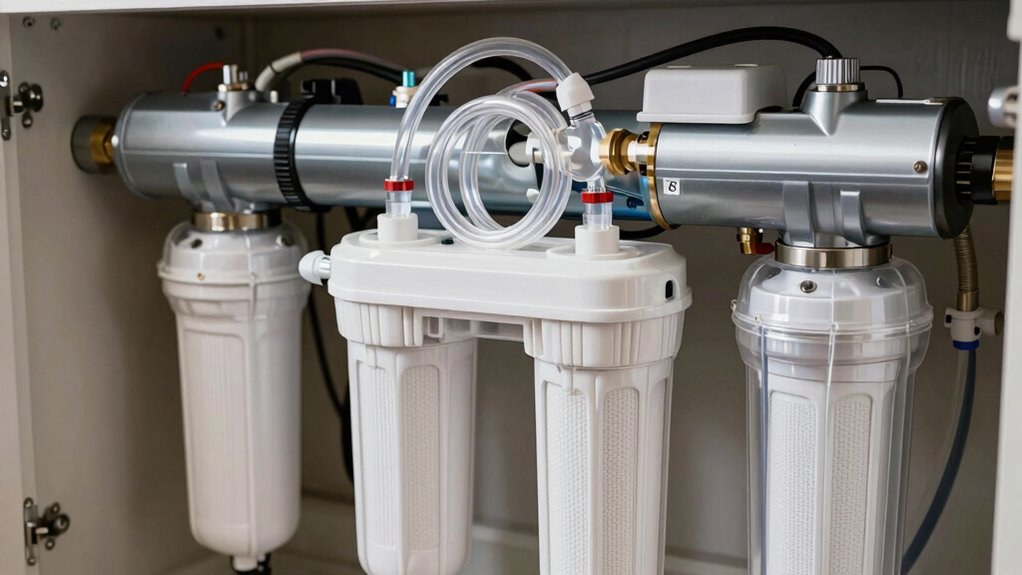

If you’re choosing between reverse osmosis (RO) and whole-house filtration, consider your needs. RO offers thorough removal of heavy metals, pesticides, and dissolved solids, but it’s mainly for drinking water and can lower pH. Whole-house systems improve overall water quality, filtering out sediment, chlorine, and VOCs, and maintain natural pH. Each has benefits and limitations, so understanding their differences can help you make the best choice for your home—there’s more to uncover if you keep exploring.

Get your next haul delivered free with Prime
- Fast, free delivery on millions of items
- Prime Video, Amazon Music and more included
- Member-only deals all year
Key Takeaways
- Reverse osmosis provides more thorough removal of dissolved contaminants but is mainly suitable for drinking water.
- Whole-house filtration improves overall water clarity and quality for all household uses, including bathing and laundry.
- RO often lowers water pH, requiring adjustments, while whole-house systems maintain natural pH balance.
- RO systems have higher maintenance and waste water, whereas whole-house filters are easier and cheaper to maintain long-term.
- Choice depends on specific water quality needs, with RO focusing on purity and whole-house systems on broad household water treatment.

When choosing a water filtration system for your home, understanding the differences between reverse osmosis and whole-house filtration can help you make an informed decision. Both systems serve to improve water quality, but they do so in distinct ways, and knowing their strengths and limitations is vital. Reverse osmosis (RO) systems are highly effective at removing contaminants like heavy metals, pesticides, and dissolved solids. They work by forcing water through a semi-permeable membrane, trapping impurities. However, this process often leads to a lower pH level in the water, which might require pH adjustment to prevent corrosion in pipes or to improve taste. RO systems usually produce a significant amount of wastewater, and their maintenance costs can add up over time, especially when filters and membranes need replacement every 6 to 12 months. They are best suited for drinking water and small-scale use, rather than whole-house applications.
Reverse osmosis systems effectively remove contaminants but may require pH adjustments and have higher maintenance costs.
On the other hand, whole-house filtration systems are designed to treat all the water entering your home. These systems typically use activated carbon filters or other media to remove chlorine, sediment, volatile organic compounds (VOCs), and improve overall water clarity. They don’t usually require pH adjustment, as they tend to maintain the water’s natural pH balance better than RO units. Whole-house filters are often more straightforward to maintain, with lower ongoing costs related to filter replacements. Since they treat water at the point of entry, they guarantee every tap delivers cleaner water for bathing, laundry, and cooking, which can be more convenient and cost-effective in the long run.
However, whole-house systems might not remove dissolved solids or certain contaminants as thoroughly as reverse osmosis does. If your water has high levels of specific impurities, an RO system might be necessary for your drinking water, but it’s less practical for whole-house use without additional treatment steps. When weighing your options, consider maintenance costs, as RO units require more frequent filter and membrane replacements, adding to long-term expenses. Whole-house systems generally have lower maintenance costs but may need upgrades or additional stages if your water contains specific pollutants.
Ultimately, your choice depends on your water quality concerns and budget. If you’re mainly focused on drinking water purity and are prepared for higher maintenance, reverse osmosis might be the right fit. But if you want a all-encompassing solution that improves water quality throughout your home with lower ongoing costs, a whole-house filtration system could be more suitable.
reverse osmosis water filtration system
As an affiliate, we earn on qualifying purchases.
As an affiliate, we earn on qualifying purchases.
Frequently Asked Questions
How Much Does Each System Cost to Install and Maintain?
You’ll find that reverse osmosis systems cost around $200 to $600 for installation, with annual maintenance roughly $100 for filter replacements, while whole-house filtration systems typically range from $1,000 to $3,000, plus similar annual upkeep costs. Both systems improve water quality, but the durability varies; reverse osmosis units may need more frequent part replacements, whereas whole-house systems tend to last longer with proper maintenance.
Which System Is Better for Removing Specific Contaminants?
If you’re aiming for contaminant specificity and filtration effectiveness, reverse osmosis systems are better at removing dissolved contaminants like heavy metals, salts, and certain chemicals. They provide highly thorough purification for specific issues. Whole-house filtration systems excel at broad-spectrum removal of sediments, chlorine, and larger particles, but may not target dissolved contaminants as effectively. Your choice depends on which contaminants concern you most and the level of filtration needed.
How Much Water Do Each of These Systems Typically Waste?
Imagine a delicate balance scale, each side representing water waste and system efficiency. Reverse osmosis tends to waste more water—about 3-4 gallons for every gallon filtered—making it less efficient. Whole-house filtration systems, however, are like a steady stream, wasting minimal water and offering higher system efficiency. You’ll find that your water waste is markedly lower with whole-house filters, helping conserve resources and reduce your overall water footprint.
Can These Systems Be Used Together for Better Filtration?
Yes, you can use reverse osmosis and whole-house filtration systems together for better water quality. Just guarantee system compatibility before installation, as combining different filtration methods can sometimes cause compatibility issues. You might face installation challenges, especially with space or plumbing adjustments. Consulting a professional helps ensure proper setup, so both systems work efficiently without interfering with each other, providing you with cleaner, safer water throughout your home.
Which System Is More Energy-Efficient Over Time?
You’ll find that whole-house filtration systems are more energy-efficient over time because they consume less energy due to their simpler design and lower water pressure requirements. Reverse osmosis systems, although effective, tend to have higher energy consumption because of the pump and filtration process. Additionally, whole-house filters generally have greater system durability, meaning less frequent replacements and repairs, which further conserves energy and maintenance costs over the years.
As an affiliate, we earn on qualifying purchases.
Conclusion
Whether you choose reverse osmosis or whole-house filtration, the decision depends on your water worries and household needs. Remember, for pure, pristine, and perfectly palatable water, prioritize your priorities. Weigh the benefits, weigh the drawbacks, and weigh your water wants. With the right system in place, you’ll enjoy fresh, flawless water straight from your faucet—free from fuss and impurities. Make your choice today and transform tap water into a tasty, trustworthy treasure.
pH adjustment for reverse osmosis system
As an affiliate, we earn on qualifying purchases.
As an affiliate, we earn on qualifying purchases.
activated carbon whole house filter
As an affiliate, we earn on qualifying purchases.
As an affiliate, we earn on qualifying purchases.
Halloween Picks
halloween
As an affiliate, we earn on qualifying purchases.