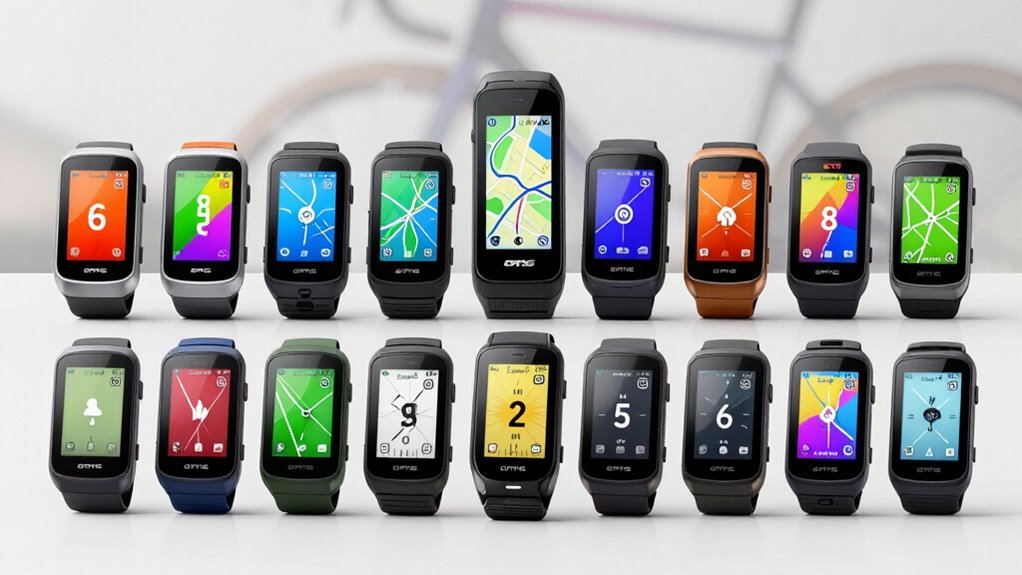

GPS bike computers have become essential tools for serious cyclists and casual riders alike, offering detailed navigation, performance tracking, and route planning. The Garmin Edge 1050 stands out as the best overall pick thanks to its comprehensive features and reliable performance, while the Wahoo ELEMNT Bolt V3 provides a sleek, lightweight design for competitive riders. Many options face tradeoffs like price versus feature set, ease of use versus advanced customization, and waterproofing versus bulk. Continue reading to see a detailed comparison of the top models and find the perfect fit for your cycling needs.
Key Takeaways
- Top models like the Garmin Edge 1050 and Edge 850 excel in performance tracking and navigation, making them ideal for serious cyclists.
- Budget-friendly options such as the CYCPLUS G1 and iGPSPORT BSC200S deliver core features at a lower cost, but may lack advanced integrations.
- Touchscreen interfaces, found on many models, simplify navigation but can drain batteries faster and may be less durable in rough conditions.
- Waterproofing and durability vary, with some models rated IPX7, suitable for all weather, while others may require extra protection.
- Ease of setup and user interface consistency are key factors that impact daily usability, especially for beginners.
| CYCPLUS Wireless GPS Bike Computer G1 |  | Best Value for Basic Navigation and Long Battery Life | Weight: 70g | Screen Size: 2.0 inches | Waterproof Rating: IPX6 | VIEW ON AMAZON | See Our Full Breakdown |
| Garmin Edge 1050 Premium Cycling Computer |  | Best for Advanced Navigation and Smart Connectivity | Battery Life: Up to 20 hours (demanding use), up to 60 hours (battery saver mode) | Display: Vivid color touchscreen | Connectivity: Smartphone, Garmin Connect app, Garmin Pay | VIEW ON AMAZON | See Our Full Breakdown |
| iGPSPORT BSC500 GPS Bike Computer with 3.3” Touchscreen, Voice Navigation, and Climb Training |  | Best for Serious Training and Route Planning | Screen Size: 3.3 inches | Navigation: GPS, Beidou, GLONASS, GALILEO, QZSS | Features: Touchscreen, voice navigation, climb training | VIEW ON AMAZON | See Our Full Breakdown |
| Garmin Edge 850 GPS Cycling Computer |  | Best for Long-Ride Navigation and Smart Features | Display: Vivid color touchscreen | Battery Life: Up to 36 hours in power saver mode | Maps: Preloaded with trail, gravel, and road maps | VIEW ON AMAZON | See Our Full Breakdown |
| GPS Bike Computer 3.26-Inch Large Screen Wireless Bicycle Speedometer |  | Best Large Screen for Clear Visibility in All Conditions | Display Size: 3.26 inches | Display Type: LED | Battery Life: 16 hours | VIEW ON AMAZON | See Our Full Breakdown |
| Wireless GPS Bike Computer, 2.4″ Screen, 650mAh, IPX7 |  | Best for Simplicity and Reliability in Basic Tracking | Screen Size: 2.4 inches | Battery Capacity: 650mAh | Battery Life: Up to 28 hours | VIEW ON AMAZON | See Our Full Breakdown |
| Wireless GPS Bike Computer, 2.4″ Screen, 650mAh, IPX7 Waterproof |  | Best for Standalone GPS Tracking and Basic Data Monitoring | Display: 2.4-inch LCD | Battery Capacity: 650mAh | Battery Life: Up to 28 hours | VIEW ON AMAZON | See Our Full Breakdown |
| Garmin Edge Explore 2 GPS Cycling Computer |  | Best for Navigation, Smart Features, and Ecosystem Integration | Display: 3-inch high-resolution touchscreen | Connectivity: Smartphone pairing, Varia device compatibility | Maps: Preloaded road, off-road, indoor | VIEW ON AMAZON | See Our Full Breakdown |
| iGPSPORT BSC300T Wireless GPS Bike Computer with Touchscreen and Offline Map Navigation |  | Best for Advanced Navigation and Data Metrics in a Versatile Package | Screen: 2.4 inch | Dimensions: 82x53x14.1mm | Weight: 67g | VIEW ON AMAZON | See Our Full Breakdown |
| iGPSPORT BSC200S GPS Bike Computer, Wireless Route Navigation 2.4″ Screen Bluetooth ANT+ Waterproof |  | Best for Versatile Connectivity and Long Battery Life | VIEW ON AMAZON | See Our Full Breakdown | |||
| Wahoo ELEMNT Bolt V3 GPS Cycling/Bike Computer, Black |  | Best for Advanced Navigation and Safety Integration | Navigation: Turn-by-turn prompts, route import from GPX, TCX, Strava, Ride With GPS, Komoot | Connectivity: Bluetooth, ANT+ | Notifications: Calls, texts, emails, messaging apps | VIEW ON AMAZON | See Our Full Breakdown |
| Garmin Edge 540 Compact GPS Cycling Computer | 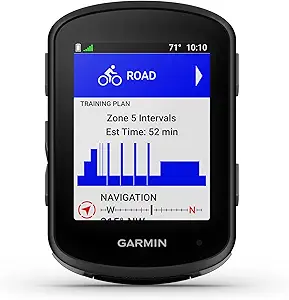 | Best for Performance Tracking and Challenging Terrains | Battery Life: up to 26 hours in demanding use, up to 42 hours in battery saver mode | Navigation: Multi-band GNSS technology for enhanced accuracy | Display: Button controls suitable for all weather conditions | VIEW ON AMAZON | See Our Full Breakdown |
| iGPSPORT BiNavi Bike Computer, 3.5” Touch Screen GPS Cycling Computer with Map Navigation and Music Control |  | Best for All-in-One Navigation and Multimedia Control | Screen Size: 3.5 inches | Navigation: GPS, Beidou, GLONASS, GALILEO, QZSS | Features: Map navigation, music control, route planning, hill climbing, training analysis | VIEW ON AMAZON | See Our Full Breakdown |
| gps bike computer | Battery Life | Connectivity |
|---|---|---|
| CYCPLUS Wireless GPS Bike Comp | Over 55 hours | — |
| Garmin Edge 1050 Premium Cycli | Up to 20 hours (demanding use), up to 60 hours (battery saver mode) | Smartphone, Garmin Connect app, Garmin Pay |
| iGPSPORT BSC500 GPS Bike Compu | — | Supports Strava, Komoot |
| Garmin Edge 850 GPS Cycling Co | Up to 36 hours in power saver mode | — |
| GPS Bike Computer 3.26-Inch La | 16 hours | — |
| Wireless GPS Bike Computer | Up to 28 hours | Sensor-free |
| Wireless GPS Bike Computer | Up to 28 hours | — |
| Garmin Edge Explore 2 GPS Cycl | — | Smartphone pairing, Varia device compatibility |
| iGPSPORT BSC300T Wireless GPS | 20H | Type-C USB |
| iGPSPORT BSC200S GPS Bike Comp | — | — |
| Wahoo ELEMNT Bolt V3 GPS Cycli | — | Bluetooth, ANT+ |
| Garmin Edge 540 Compact GPS Cy | up to 26 hours in demanding use, up to 42 hours in battery saver mode | — |
| iGPSPORT BiNavi Bike Computer | — | Wireless, app support for route transfer |
More Details on Our Top Picks
CYCPLUS Wireless GPS Bike Computer G1
This option stands out for cyclists who prioritize simplicity, long-lasting battery, and weather resistance. Compared with the Garmin Edge 1050, the CYCPLUS G1 offers a more straightforward, less feature-rich experience, making it ideal for casual riders who don’t need advanced navigation or performance metrics. Its lightweight design and IPX6 waterproof rating mean it performs reliably in diverse conditions, and the 55+ hour battery life surpasses most competitors, reducing the need for frequent recharging. However, it lacks advanced training analytics and smart notifications, which can be a drawback for serious training enthusiasts. The automatic sleep mode may require manual wake-up, adding minor inconvenience for some users. Overall, this pick makes the most sense for riders who want dependable basic tracking without extra features.
Pros:- High-accuracy GPS tracking for reliable data
- Bright, glare-free display visible in sunlight
- Waterproof design suitable for all weather conditions
- Exceptional battery life of over 55 hours
Cons:- Limited to basic cycling data; no advanced metrics
- Automatic sleep mode may require manual activation
Best for: Casual cyclists seeking reliable GPS tracking and long battery life at an affordable price
Not ideal for: Competitive or training-focused cyclists who need detailed metrics and coaching features
- Weight:70g
- Screen Size:2.0 inches
- Waterproof Rating:IPX6
- Battery Capacity:1200mAh
- Battery Life:Over 55 hours
Our verdict“This device is perfect for riders who want straightforward GPS tracking and durability without extra bells and whistles.”
Garmin Edge 1050 Premium Cycling Computer
The Garmin Edge 1050 is tailored for serious cyclists who need detailed maps, performance analytics, and connectivity. Unlike the iGPSPORT BSC500, which excels with a large touchscreen and voice alerts, the Edge 1050 offers a high-resolution color display with more comprehensive navigation features, including advanced route planning and hazard alerts. Its long battery life of up to 20 hours in demanding use makes it suitable for long-distance rides, but the premium price and complex feature set may be overwhelming for casual users. The reliance on compatible apps and devices for full functionality can also add to the learning curve. This makes it an excellent choice for users who want a high-end device with extensive performance tracking, but less ideal for those seeking a simple, budget-friendly option.
Pros:- High-resolution color touchscreen with intuitive interface
- Extended battery life suitable for long rides
- Comprehensive navigation and hazard alert features
- Smart connectivity including notifications and incident detection
Cons:- Premium price may be prohibitive for casual users
- Complex feature set requires familiarization
- Heavy reliance on connected devices for full features
Best for: Experienced cyclists and performance enthusiasts who value detailed maps and connectivity
Not ideal for: Beginners or casual riders who prefer a straightforward, less expensive device
- Battery Life:Up to 20 hours (demanding use), up to 60 hours (battery saver mode)
- Display:Vivid color touchscreen
- Connectivity:Smartphone, Garmin Connect app, Garmin Pay
- Features:Navigation, hazard alerts, in-ride messaging, incident detection
- Size:Not specified
Our verdict“This device is best suited for committed cyclists who need detailed navigation, analytics, and smart features in one package.”
iGPSPORT BSC500 GPS Bike Computer with 3.3” Touchscreen, Voice Navigation, and Climb Training
This model makes the most sense for cyclists who want a larger display and advanced training features. The 3.3-inch touchscreen simplifies navigation, and the support for multiple satellite systems ensures precise positioning compared to the GPS-only GPS Bike Computer with 3.26-inch screen. Its voice navigation minimizes distractions, a key advantage over simpler devices like the Garmin Edge 850, which relies more on visual cues. However, the battery life isn’t specified, which could be limiting for long outings, and the array of features may require a learning curve for new users. It’s most suitable for dedicated training riders who appreciate detailed route import/export and climb analytics, but less ideal for casual or infrequent riders.
Pros:- Large, easy-to-use touchscreen display
- Supports multiple satellite systems for high accuracy
- Voice navigation improves safety by reducing screen interaction
- Advanced climb training and route management
Cons:- Battery life isn’t specified, raising concerns for all-day rides
- Complex features may require time to master
- Limited third-party app integration details
Best for: Cyclists focused on training, route customization, and voice-guided navigation
Not ideal for: Occasional riders who want a simple, plug-and-play device without steep learning curves
- Screen Size:3.3 inches
- Navigation:GPS, Beidou, GLONASS, GALILEO, QZSS
- Features:Touchscreen, voice navigation, climb training
- Connectivity:Supports Strava, Komoot
Our verdict“Ideal for serious riders who need detailed training tools and effective route guidance with a large display.”
Garmin Edge 850 GPS Cycling Computer
The Garmin Edge 850 combines a vivid color touchscreen with button controls, providing a balance for riders who prefer tactile feedback alongside visual clarity. Compared to the iGPSPORT BSC500, this device offers preloaded maps and a longer battery life of up to 36 hours in power saver mode, making it suitable for extended adventures. Its extensive navigation options, including Trailforks integration, and smart features like incident detection, make it a strong contender for riders who need reliable, detailed maps and safety alerts. However, its complex features can present a learning curve, and its higher price may deter casual users. The reliance on pairing with smartphones for full functionality adds some dependency on external devices. Overall, the Edge 850 is well-suited for experienced cyclists seeking a feature-rich, long-lasting GPS device.
Pros:- Vivid color display with tactile button controls
- Up to 36 hours of battery life for extended rides
- Preloaded maps including trail and gravel options
- Smart safety features like incident detection and Garmin Pay
Cons:- Complex interface requiring some familiarity
- Premium price might be high for occasional users
- Heavy reliance on smartphone pairing for full experience
Best for: Long-distance riders and serious cyclists who value detailed navigation and safety features
Not ideal for: Casual riders or beginners who want a simple, straightforward GPS computer
- Display:Vivid color touchscreen
- Battery Life:Up to 36 hours in power saver mode
- Maps:Preloaded with trail, gravel, and road maps
- Additional Features:Incident detection, Garmin Pay, weather overlays
Our verdict“This model is best for riders who need a comprehensive, long-lasting device with advanced navigation and safety options.”
GPS Bike Computer 3.26-Inch Large Screen Wireless Bicycle Speedometer
This GPS bike computer is tailored for riders who prioritize an exceptionally large, anti-glare display. Unlike the iGPSPORT BSC500, which supports multiple satellite systems, this device focuses on dual GPS+BDS for straightforward, accurate positioning. Its 3.26-inch LED screen is highly visible in bright sunlight, making it ideal for riders who need clarity without fiddling with settings. The 16-hour battery life is suitable for day trips, but it’s less ideal for multi-day adventures, especially compared to the longer-lasting models like the Garmin Edge 1050. Its waterproof IPX6 rating ensures durability in all weather, yet it lacks support for advanced metrics or sensor integrations, limiting its feature set. It’s a good choice for casual riders who want a simple, easy-to-read display.
Pros:- Enormous, anti-glare LCD display enhances visibility
- Dual GPS+BDS for accurate positioning without calibration
- Waterproof design for all-weather riding
- Rechargeable battery lasting up to 16 hours
Cons:- Limited to GPS and BDS satellites; no sensor support
- No advanced metrics or training features
- Requires handlebar mounting, which may not suit all bikes
Best for: Day riders and commuters who need a large, clear display with reliable GPS tracking
Not ideal for: Training enthusiasts or long-distance riders requiring detailed analytics and multi-day battery life
- Display Size:3.26 inches
- Display Type:LED
- Battery Life:16 hours
- Waterproof Rating:IPX6
- Sensor Support:GPS, BDS
Our verdict“This device is ideal for riders wanting a large, easy-to-read display and reliable GPS tracking in everyday riding conditions.”
Wireless GPS Bike Computer, 2.4″ Screen, 650mAh, IPX7
This model stands out for its straightforward, sensor-free setup and a clear, backlit display that works well in daylight and darkness. Compared with the Garmin Edge Explore 2, it offers fewer advanced features like maps and smart notifications, but excels in battery longevity and waterproof durability. Its focus on core ride metrics makes it ideal for riders who want reliable data without added complexity. However, the lack of app connectivity limits customization and data analysis options, making it less suited for tech-savvy cyclists. The 650mAh battery ensures up to 28 hours of use, perfect for long rides, but the device’s simplicity means it won’t satisfy those seeking detailed performance metrics or advanced navigation.
Pros:- Clear display with automatic backlight for day and night use
- Sensor-free setup allows quick installation
- Long battery life up to 28 hours for extended rides
- IPX7 waterproof rating withstands wet conditions
Cons:- Limited to basic ride data, no advanced metrics
- No support for app integration or external sensors
Best for: Cyclists who want a dependable, easy-to-use GPS computer for basic ride tracking without extra frills
Not ideal for: Riders seeking advanced mapping, live traffic updates, or smartphone connectivity, as these features are missing
- Screen Size:2.4 inches
- Battery Capacity:650mAh
- Battery Life:Up to 28 hours
- Waterproof Rating:IPX7
- Display Type:LCD
- Connectivity:Sensor-free
Our verdict“This device is perfect for riders who prioritize straightforward, reliable tracking over advanced features.”
Wireless GPS Bike Computer, 2.4″ Screen, 650mAh, IPX7 Waterproof
This option offers the same core features as the B0FN84KGWW but adds GPS tracking, auto start/stop, and backlight options. It’s better suited to riders who want a simple, sensor-free device with a few extra functionalities for more accurate ride recording. Compared to the Garmin Edge Explore 2, it lacks preloaded maps and smart notifications, but it compensates with an IPX7 waterproof design that performs well in wet weather. Its straightforward setup and long battery life make it a solid choice for outdoor riders focused on basic metrics like speed, distance, and altitude. The absence of app integration limits data analysis, so serious performance tracking is not its strength.
Pros:- Easy to set up without external sensors
- Long-lasting battery for extended rides
- Clear display with automatic backlight
- Waterproof IPX7 design handles rain and splashes
Cons:- No app connection or advanced customization
- Limited to standalone GPS without map navigation
Best for: Cyclists who prefer a simple, standalone GPS device with reliable waterproof performance
Not ideal for: Riders wanting detailed navigation guidance, route planning, or smartphone notifications
- Display:2.4-inch LCD
- Battery Capacity:650mAh
- Battery Life:Up to 28 hours
- Waterproof:IPX7
- Features:GPS, auto start/stop, backlight
Our verdict“This model is ideal for riders seeking an uncomplicated, durable GPS computer for core ride data.”
Garmin Edge Explore 2 GPS Cycling Computer
The Garmin Edge Explore 2 makes navigation intuitive with its 3-inch high-resolution touchscreen, offering excellent visibility in various conditions. It’s the best choice for cyclists who want preloaded maps, live traffic updates, and smart connectivity like smartphone pairing and incident detection. Compared to simpler models like the B0FGXPLVRR, it provides extensive navigation options and smart notifications, though at a higher cost and with a more complex interface. Its compatibility with sensors and Varia devices adds versatility for performance monitoring and safety. However, some features require additional purchases, and it functions best within the Garmin ecosystem, which may limit flexibility for users with other brands.
Pros:- Glove- and rain-friendly touchscreen interface
- Preloaded maps with ride-specific features
- Smart notifications and live traffic updates
- Compatible with a variety of sensors and Varia devices
Cons:- Additional purchase needed for sensors and Varia accessories
- Higher price point compared to basic GPS units
Best for: Serious cyclists who want comprehensive navigation and smart connectivity integrated into their ride experience
Not ideal for: Casual riders who don’t want to invest in sensors or prefer a simple, screen-only device
- Display:3-inch high-resolution touchscreen
- Connectivity:Smartphone pairing, Varia device compatibility
- Maps:Preloaded road, off-road, indoor
- Features:LiveTrack, GroupTrack, incident detection
- Sensors:Heart rate, bike speed, cadence (sold separately)
Our verdict“This device is tailored for cyclists seeking a feature-rich, connected navigation experience within the Garmin ecosystem.”
iGPSPORT BSC300T Wireless GPS Bike Computer with Touchscreen and Offline Map Navigation
The BSC300T stands out with a large 2.4-inch touchscreen and support for global offline maps, making it a top choice for serious outdoor cyclists and e-bike riders. Compared to simpler devices like the B0FN84KGWW, it offers detailed route navigation, off-course alerts, and over 130 data metrics, making it highly customizable for performance tracking. Its compatibility with multiple sensors and devices enhances versatility for competitive riders. The main tradeoffs include a somewhat complex setup process and a shorter 20-hour battery life, which might not suit ultra-long riders. Nonetheless, this device balances extensive data, navigation, and sensor support in a compact, lightweight design.
Pros:- Large touchscreen with easy operation
- Supports global offline maps and route navigation
- Supports multiple sensors and devices including e-bikes
- Over 130 data metrics and real-time tracking
Cons:- No included charging cable, must purchase separately
- Battery life of 20 hours may be limiting for very long rides
- Setup can be complex for new users
Best for: Experienced cyclists and e-bike users who need advanced navigation and detailed data metrics
Not ideal for: Casual riders or those seeking a simple, plug-and-play device with minimal setup
- Screen:2.4 inch
- Dimensions:82x53x14.1mm
- Weight:67g
- Battery Life:20H
- Waterproof Grade:IPX7
- Connectivity:Type-C USB
Our verdict“This device is well-suited for cyclists who need detailed navigation, extensive data, and sensor integration for serious performance tracking.”
iGPSPORT BSC200S GPS Bike Computer, Wireless Route Navigation 2.4″ Screen Bluetooth ANT+ Waterproof
The BSC200S combines a bright 2.4-inch display with route navigation and extensive sensor compatibility, making it a flexible choice for a range of cycling activities. Compared with the BSC300T, it offers a slightly longer battery life of 25 hours and supports a broader array of sensors and lights, which is advantageous for riders who want to customize their setup. The reliance on physical buttons rather than a touchscreen can appeal to those who prefer tactile controls in wet or muddy conditions, but it may feel less intuitive to tech-savvy users. Its ability to connect with numerous sensors and accessories makes it highly adaptable, yet the setup process can be complex for new users unfamiliar with GPS devices.
Pros:- Bright, sunlight-visible display
- Long battery life of up to 25 hours
- Supports a wide range of sensors and lights
- Waterproof IPX7 rating
Cons:- Setup process may be challenging for beginners
- No touchscreen interface, relies on physical buttons
- Limited user interface intuitiveness for some
Best for: Cyclists seeking a durable, highly compatible GPS device with long battery life and physical controls
Not ideal for: Riders who prefer touchscreen interfaces or minimal setup, as it relies on physical buttons and can be complex to configure
Our verdict“This bike computer suits riders who prioritize connectivity, battery longevity, and rugged controls over touchscreen ease of use.”
Wahoo ELEMNT Bolt V3 GPS Cycling/Bike Computer, Black
The Wahoo ELEMNT Bolt V3 stands out for its comprehensive navigation features, including turn-by-turn prompts with audible and LED cues, making it ideal for riders who prioritize clarity and safety. Its ability to automatically download routes from platforms like Strava and Komoot simplifies planning, while live tracking and smart notifications keep cyclists connected and protected. Compared to the Garmin Edge 540, this device offers more integrated safety features like ANT+ radar support, though its setup process can be daunting for newcomers. The higher price might deter casual riders, but those seeking a blend of advanced navigation and real-time safety alerts will find it worthwhile.
Pros:- Advanced turn-by-turn navigation with audible and LED cues
- Automatic route downloads and seamless workout uploads
- Real-time live tracking and smart notifications for safety and connectivity
- Supports ANT+ radar for vehicle proximity alerts
Cons:- Complex setup may challenge beginners
- Relies heavily on smartphone connection for some features
- Higher price compared to basic GPS bike computers
Best for: Serious cyclists who want detailed navigation, live tracking, and vehicle proximity alerts.
Not ideal for: Beginners or casual riders who prefer a simple, straightforward device without complex setup or safety integrations.
- Navigation:Turn-by-turn prompts, route import from GPX, TCX, Strava, Ride With GPS, Komoot
- Connectivity:Bluetooth, ANT+
- Notifications:Calls, texts, emails, messaging apps
- Compatibility:iOS, Android
- Radar Integration:ANT+ Rearview radar support
Our verdict“This GPS computer is best suited for experienced cyclists who need detailed navigation and safety features integrated into their ride data.”
Garmin Edge 540 Compact GPS Cycling Computer
The Garmin Edge 540 makes a strong case for cyclists who need precise navigation and performance metrics, especially in tough environments where multi-band GNSS technology shines. Its advanced positioning accuracy supports challenging terrains, and features like personalized coaching and stamina insights help riders improve over time. Compared with the Wahoo ELEMNT Bolt V3, the Edge 540 offers a more performance-focused experience but involves a steeper learning curve due to its extensive feature set. Its durable button controls are usable in all weather, yet its higher cost may be a deterrent for casual users. This device is designed for cyclists committed to training and performance optimization.
Pros:- Multi-band GNSS technology for precise positioning in challenging environments
- Personalized coaching and stamina insights to enhance performance
- Weather-resistant button controls suitable for all conditions
- Ride-specific maps highlighting popular roads and trails
Cons:- Steep learning curve for unfamiliar users
- Higher price point compared to entry-level devices
- Battery life can vary significantly with usage intensity
Best for: Performance-oriented cyclists tackling varied terrains and seeking detailed ride analytics.
Not ideal for: Casual riders or beginners who won’t utilize advanced training features or need simpler navigation tools.
- Battery Life:up to 26 hours in demanding use, up to 42 hours in battery saver mode
- Navigation:Multi-band GNSS technology for enhanced accuracy
- Display:Button controls suitable for all weather conditions
- Features:Personalized coaching, ClimbPro ascent planner, stamina insights, ride maps
Our verdict“Ideal for dedicated cyclists focusing on performance metrics and challenging terrain navigation, despite its complexity and cost.”
iGPSPORT BiNavi Bike Computer, 3.5” Touch Screen GPS Cycling Computer with Map Navigation and Music Control
The iGPSPORT BiNavi combines extensive navigation options with entertainment features, making it appealing to riders who want an integrated experience. Its large 3.5-inch touch screen supports route planning, map navigation, and music control, which can enhance riding safety by reducing device distractions. The dual-band GPS and support for multiple satellite systems improve accuracy in challenging environments, rivaling Garmin’s multi-band GNSS offerings. However, the absence of detailed battery life information and the dependence on smartphone apps for some features may be drawbacks for long rides. This pick makes the most sense for cyclists who prefer an all-in-one device for navigation, training, and entertainment, but less so for those concerned about battery longevity or standalone independence.
Pros:- Supports comprehensive navigation and route planning
- Music control integrated for safer riding
- Advanced dual-band GPS with multiple satellite support
- Includes training analysis features
Cons:- Battery life details are not specified, limiting planning for long rides
- Some features depend on smartphone compatibility and apps
- Price and availability are unclear, which could impact value
Best for: Cyclists seeking a versatile device with navigation, music, and training analysis in a single compact package.
Not ideal for: Long-distance riders or those requiring detailed battery life estimates and extensive standalone capabilities.
- Screen Size:3.5 inches
- Navigation:GPS, Beidou, GLONASS, GALILEO, QZSS
- Features:Map navigation, music control, route planning, hill climbing, training analysis
- Connectivity:Wireless, app support for route transfer
- Battery:Not specified
Our verdict“This device suits riders who want an all-in-one navigation, entertainment, and training tool, provided they are okay with limited battery lifespan details.”

How We Picked
In selecting these GPS bike computers, I prioritized performance capabilities such as accuracy, battery life, and navigation features, as these directly influence riding experience. Usability was also critical—models needed intuitive interfaces, clear displays, and straightforward setup. Build quality and waterproof ratings ensured durability for outdoor use. I also considered value, balancing price against features to highlight options suitable for different budgets. Lastly, versatility, such as compatibility with sensors and smartphones, informed the ranking, ensuring each product offers a meaningful advantage for its target user.Factors to Consider When Choosing Gps Bike Computers
Choosing the right GPS bike computer involves several key considerations. Beyond basic navigation, riders should evaluate battery life, display quality, and ease of use. Compatibility with sensors and apps can expand functionality, but may add complexity. Waterproofing and durability ensure the device withstands weather and rough conditions. Price often reflects feature depth, so understanding your riding style and needs helps avoid overpaying or missing out on essential features. By weighing these factors, you can select a model that enhances your cycling without unnecessary extras.Performance and Accuracy
Reliable GPS signal and precise tracking are fundamental for meaningful route mapping and performance analysis. Devices with dual satellite compatibility (GPS, GLONASS, Galileo) tend to offer better accuracy in challenging environments like tunnels or wooded areas. Consider battery life, especially for long rides, to prevent interruptions. The most advanced models balance high accuracy with extended battery performance, which is critical for multi-hour adventures.
Ease of Use and Interface
An intuitive user interface makes a significant difference, particularly during rides when quick access to data is needed. Touchscreens provide faster navigation but can be less responsive in cold or wet conditions. Physical buttons, while more durable in some cases, may require more effort to operate. Clear display layouts and customizable screens help users focus on the metrics that matter most, reducing distraction and enhancing safety.
Durability and Waterproofing
Since cycling often involves exposure to rain, mud, and rough handling, waterproof ratings like IPX7 or higher are worth prioritizing. Some models are built with rugged cases to withstand shocks and vibrations, extending their lifespan. Consider your typical riding environment—if you frequently ride in foul weather, a highly rated waterproof device will save you from replacements or repairs.
Compatibility and Connectivity
Most riders benefit from devices that connect seamlessly with heart rate monitors, power meters, and smartphone apps. Bluetooth and ANT+ compatibility expand sensor options, allowing for comprehensive performance tracking. Make sure the device integrates with your preferred training platforms or navigation apps, especially if you plan to analyze rides or share routes regularly. Compatibility can also influence ease of updating maps and firmware over time.
Price and Value
High-end models offer advanced features like offline maps and extensive customization, but at a premium cost. Budget options focus on core functionalities like basic navigation and ride recording, which suit casual riders. Evaluating your riding frequency, goals, and desired features will help determine if investing in a premium device improves your experience or if a more affordable model suffices. Remember that higher-priced units often include better build quality and durability, which may justify the price for frequent riders.
Frequently Asked Questions
How accurate are GPS bike computers compared to smartphone navigation apps?
GPS bike computers generally provide more accurate and reliable data during rides because they are optimized for outdoor activities and have dedicated antennas and GPS chips. Unlike smartphones, which may switch between networks and experience signal interruptions, dedicated devices maintain stable satellite connections, especially in challenging environments like tunnels or wooded areas. While some smartphone apps are highly capable, a purpose-built GPS bike computer typically offers better accuracy, longer battery life, and more targeted features for cycling.
Can I use a GPS bike computer without pairing it with other sensors?
Yes, many GPS bike computers can function independently for basic tracking and navigation. They record ride data such as distance, speed, and location without additional sensors. However, pairing sensors like heart rate monitors, cadence, or power meters enhances data accuracy and provides more comprehensive performance insights. If your primary goal is simple navigation and ride logging, a standalone GPS device may be sufficient; for detailed training analysis, sensor compatibility becomes more important.
How important is screen size on a GPS bike computer?
Screen size impacts both visibility and ease of use during rides. Larger displays make it easier to read data at a glance, reducing the need to stop or squint. However, bigger units tend to be heavier and bulkier, which can affect handling and comfort. Smaller screens are more streamlined and less obtrusive, but may require more scrolling or zooming to view details. Choosing a size depends on your riding style, whether you prioritize quick data access or prefer a more compact device.
Are waterproof GPS bike computers worth the extra cost?
Investing in waterproof models is often worthwhile if you frequently ride in rain or muddy conditions. Waterproofing protects internal electronics from damage, extending the device’s lifespan and reducing maintenance. Non-waterproof units may require additional covers or careful handling, which can be inconvenient. For regular outdoor riders, a device with an IPX7 or higher rating offers peace of mind and consistent performance, justifying the additional expense.
Do I need a GPS bike computer with offline maps?
Offline maps are particularly valuable for riders who venture into unfamiliar or remote areas where cellular signals are weak or unavailable. They allow navigation without relying on a phone connection, providing peace of mind and continuous guidance. However, these maps often come at a higher price and may require more storage space. If you mainly ride in well-known areas or prefer smartphone navigation, a device without offline maps might save money while still meeting your needs.
Conclusion
For most riders, the Garmin Edge 1050 offers the best blend of comprehensive features, durability, and user experience, making it the top choice for serious cyclists. Those on a budget or new to cycling might prefer the iGPSPORT BSC200S for simplicity and affordability. If you seek a lightweight, sleek design for competitive riding, the Wahoo ELEMNT Bolt V3 stands out. Casual riders or commuters should consider models with basic features and good waterproofing, while adventure cyclists will benefit from devices with offline maps and rugged build. Ultimately, your choice should align with your riding style, goals, and budget to get the most value from your investment.