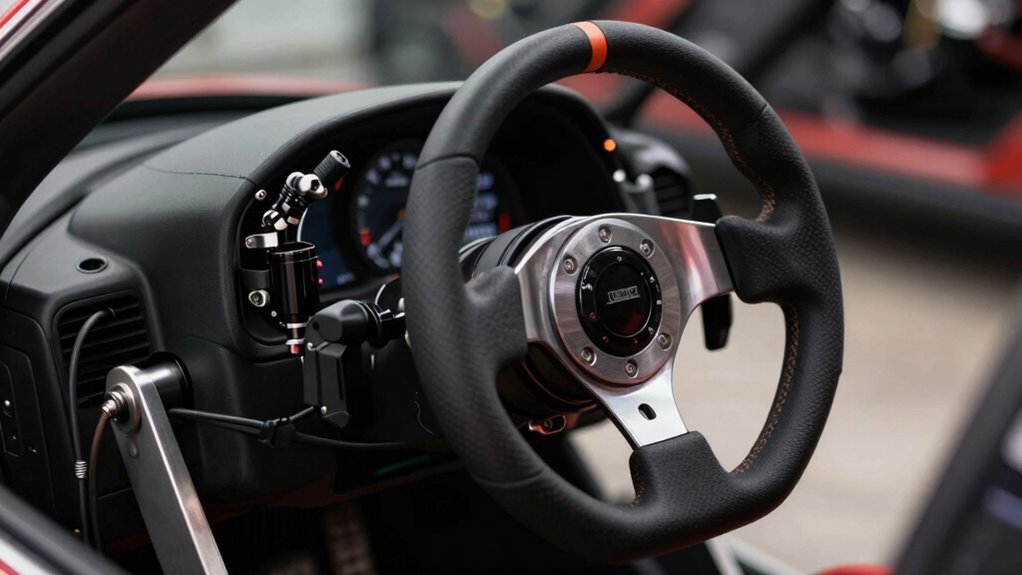

Force feedback in racing wheels uses motors and smart algorithms to mimic real driving sensations, like changes in terrain, tire grip, or weight shifts. These motors respond to game data, providing you with physical cues that enhance control and immersion. Proper calibration guarantees the sensations feel natural and accurate, making your experience more realistic. If you’re curious about how these mechanisms work together to create such a convincing feel, keep exploring to uncover more details.
Key Takeaways
- Force feedback uses motors in the wheel to simulate real driving sensations like bumps and turns.
- It translates game data into physical forces, making gameplay more immersive and realistic.
- Proper calibration ensures the feedback feels natural and matches the player’s setup.
- Real-time data processing adjusts forces instantly to reflect terrain, speed, and vehicle behavior.
- Advanced algorithms interpret game physics to create a dynamic, responsive steering experience.
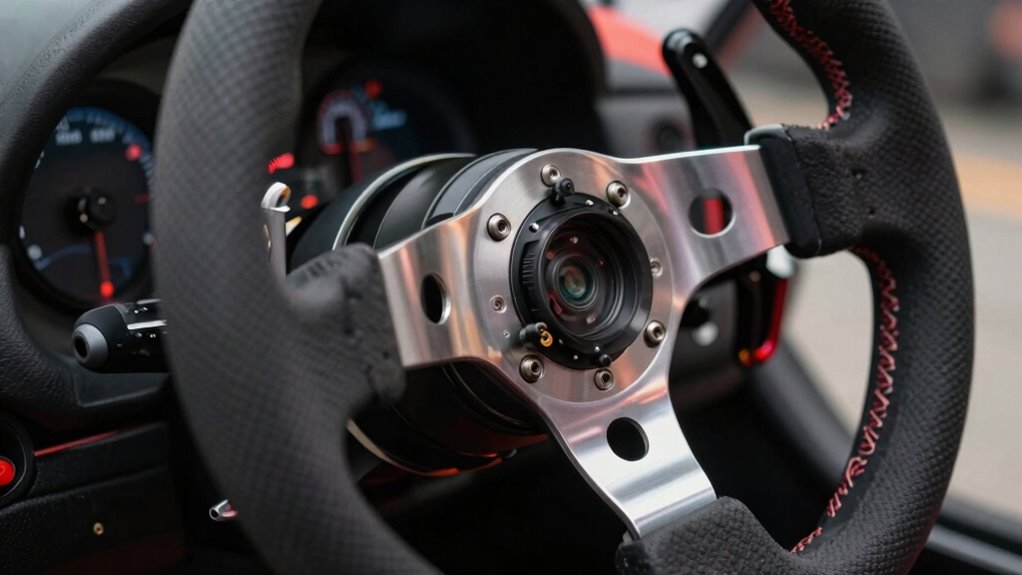
Racing wheel force feedback is a essential feature that enhances your driving experience by simulating real-world road conditions and vehicle dynamics. It’s what makes your wheel respond to the terrain, the grip of the tires, and the weight transfer of the car, giving you a more immersive and realistic feel. At the core of this technology are force feedback mechanisms, which are responsible for translating digital signals into physical sensations. These mechanisms use motors within the wheel to apply varying forces based on what’s happening in the game, whether you’re steering a sharp turn or driving over rough terrain. Understanding how these mechanisms work helps you appreciate how your wheel reacts and provides better control during gameplay. Proper calibration is crucial because it ensures the force feedback feels natural and matches the specific characteristics of your setup. Calibration involves adjusting settings such as the overall strength of the feedback, the dead zones where no force is felt, and the rotation angle of the wheel itself. Proper calibration prevents the feedback from feeling too weak or too strong, which can cause fatigue or reduce immersion. Many racing games and software include built-in calibration tools, making it easier for you to fine-tune your wheel to suit your preferences. Taking the time to calibrate correctly means you’ll experience more precise and realistic sensations, making every turn and bump feel authentic. Additionally, calibration tools are often designed to simplify this process, allowing even beginners to optimize their setup effectively. This process is essential because real-time data processing ensures the feedback remains accurate and responsive during gameplay. Understanding how force feedback algorithms process data helps you grasp how your wheel can deliver such a convincing experience. Basically, they rely on complex algorithms that process game data in real-time. When your car accelerates, brakes, or encounters uneven surfaces, the system quickly interprets these inputs and adjusts the motors accordingly. This continuous interaction creates a dynamic and responsive feel, which is essential for competitive racing or just enjoying a more lifelike simulation. The better your force feedback mechanisms are calibrated, the more accurately these sensations mirror real-world physics. This means you’ll feel every detail, from the subtle change in tire grip to the impact of hitting an obstacle. Understanding force feedback mechanisms helps you appreciate the technology behind the immersive experience.
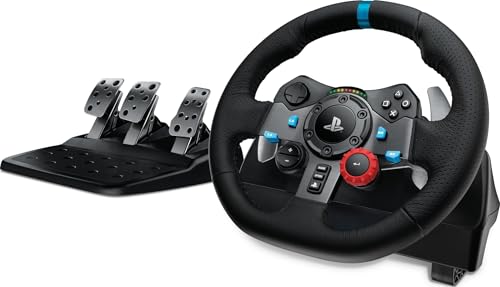
Logitech G29 Racing Wheel and Pedals for PS5/PS4/PC
- Platform Compatibility: PS5, PS4, and PC gaming
- Immersive Driving Experience: Realistic steering and pressure-sensitive pedals
- Premium Feedback Control: Smooth, quiet steering with helical gearing
As an affiliate, we earn on qualifying purchases.
As an affiliate, we earn on qualifying purchases.
Frequently Asked Questions
How Does Force Feedback Improve Racing Simulation Realism?
Force feedback enhances your racing simulation realism by using haptic technology to mimic real-world sensations, like tire grip and road surface changes. When you steer, you feel vibrations and resistance that react to your actions and the virtual environment. This creates an immersive experience, making you feel truly connected to the car and track. As a result, your gameplay feels more authentic, improving both enjoyment and skill development.
Can Force Feedback Cause Fatigue During Long Gaming Sessions?
Yes, force feedback can cause fatigue during long gaming sessions. You might experience muscle strain from constant gripping and controlling the wheel, or sensory overload from continuous vibrations and resistance. This can lead to discomfort, tiredness, and decreased focus. To prevent this, take regular breaks, adjust the feedback intensity, and maintain good posture. Doing so helps you enjoy your racing experience without risking fatigue or strain.
What Maintenance Is Required for Force Feedback Systems?
You should regularly check your force feedback system for calibration issues to guarantee smooth performance. Keep the hardware durable by cleaning connections and tightening loose screws. Updating firmware and drivers also helps prevent calibration problems. Avoid excessive force to prolong the hardware’s lifespan. Periodic maintenance like inspecting the motor and gears keeps your system reliable, reducing wear and tear, and ensuring consistent force feedback during long gaming sessions.
How Do Different Racing Games Utilize Force Feedback Differently?
You might think all racing games feel the same, but they actually utilize force feedback differently. Some emphasize realistic wheel vibration, mimicking tire grip and road texture, while others focus on force feedback calibration to exaggerate impacts or drifting. This variation immerses you uniquely in each game, making your wheel’s response a vital part of the experience. So, don’t just settle for one style—explore how each title uses force feedback to enhance your drive.
Is Force Feedback Necessary for an Authentic Racing Experience?
Force feedback isn’t strictly necessary for an authentic racing experience, but it substantially enhances immersion. When you use force feedback in virtual reality, you feel every bump and turn, making the experience more real. Without it, you might miss subtle cues, which can lead to a less engaging session. However, some users may experience motion sickness, so choosing the right level of force feedback can help balance realism and comfort.
gaming steering wheel with force feedback
As an affiliate, we earn on qualifying purchases.
As an affiliate, we earn on qualifying purchases.
Conclusion
Now that you understand racing wheel force feedback, you’re practically a racing legend in the making. With every turn, bump, and scrape, you’ll feel like you’re actually on the track, controlling a thunderous beast of speed and power. It’s not just about gaming anymore—it’s an adrenaline-fueled symphony of sensations coursing through your hands, transforming your living room into a racing arena where you’re the unstoppable champion. Get ready to free your inner speed demon like never before!
professional racing wheel calibration tools
As an affiliate, we earn on qualifying purchases.
As an affiliate, we earn on qualifying purchases.
force feedback racing wheel accessories
As an affiliate, we earn on qualifying purchases.
As an affiliate, we earn on qualifying purchases.